


|
MINISTRY OF AGRICULTURE AND ENVIRONMENT OF VIETNAM |
THE SOCIALIST REPUBLIC OF VIETNAM |
|
No. 03/2026/TT-BNNMT |
Hanoi, January 13, 2026 |
ON QUARANTINE OF AQUATIC ANIMALS AND PRODUCTS THEREOF
Pursuant to the Law on Veterinary Medicine in 2015;
Pursuant to the Law on amendments to some articles of 15 Laws in the field of agriculture and environment in 2025;
Pursuant to Decree No. 35/2025/ND-CP dated February 25, 2025 of the Government on functions, tasks, powers and organizational structure of the Ministry of Agriculture and Environment of Vietnam;
At the request of the Director General of the Department of Livestock Production and Animal Health;
The Minister of Agriculture and Environment on quarantine of aquatic animals and products thereof.
Article 1. Scope and regulated entities
1. Scope
This Circular elaborates clause 3, Article 53; clause 2, Article 55; clause 2, Article 56; clause 2, Article 57; and Article 58 of the Law on Veterinary Medicine (amended by the Law on amendments to some articles of 15 Laws in the field of agriculture and environment in 2025) regarding:
a) The list of aquatic animals and products thereof subject to quarantine, and those exempt from quarantine; The list of aquatic animals and their products that have to undergo risk analysis before being imported into Vietnam; The list of subjects of quarantine of aquatic animals and products thereof;
b) Regulations and procedures for quarantine of aquatic animals and products thereof that are transported out of provinces; export, import, temporary import for re-export, temporary export for re-import, transport of point, bonded warehouses, transit through Vietnam’s territory; quarantine of aquatic animals used as participants in fairs, exhibitions, sports competitions and artistic performances; quarantine of aquatic animal products used as participants in fairs and exhibitions; transportation of aquatic disease specimens.
2. Regulated entities
This Circular applies to authorities, organizations and individuals related to activities prescribed in clause 1 of this Article.
For the purposes of this Circular, the terms below shall be construed as follows:
1. Aquatic animals used for breeding are aquatic animals used for producing offspring, breeding for commercial farming, ornamental purposes, recreation or other purposes.
2. Commercial aquatic animals are live aquatic animals used as food; as raw materials for food processing, animal feed, aquatic feed or other purposes, excluding breeding purposes.
3. Aquatic animal quarantine sites are places where aquatic animals are kept for a period to carry out quarantine procedures.
4. Aquatic animal product quarantine sites are warehouses, containers, or means of storage used for preservation of aquatic animal products for a period to carry out quarantine procedures.
5. Exported and imported items are aquatic animal products of the same type, name, brand, production facility and packaging material.
6. Shipment of exported or imported aquatic animal products refers to the entire batch of aquatic animal products in one import or export consignment with the same bill of lading or transport contract (if any). A shipment may consist of one or multiple items.
7. High-risk aquatic animal products are aquatic animal products in the form of raw, fresh, chilled or frozen products.
8. Low-risk aquatic animal products are aquatic animal products not prescribed in clause 7 of this Article.
9. Clinical inspection is the inspection of the health status of aquatic animals based on the evaluation of external symptoms to detect abnormalities or signs of aquatic animal diseases.
10. Physical inspection of commodities is the inspection of preservation conditions, packaging standards, appearance, product types, product labels and detailed information of the shipment.
11. Persons collecting samples of animal and their product are civil servants appointed for animal quarantine; or persons holding Intermediate Diploma or higher in animal husbandry, veterinary medicine, aquaculture, aquatic pathology, or animal husbandry and veterinary medicine, and who have been granted certificates or certifications of completing training courses in quarantine of animals and products thereof organized by the Department of Livestock Production and Animal Health or authorized units.
Article 3. The list of aquatic animals and products thereof subject to quarantine, and those exempt from quarantine; The list of aquatic animals and their products that have to undergo risk analysis before being imported into Vietnam; The list of subjects of quarantine for aquatic animals and products thereof
1. The list of aquatic animals and products thereof subject to quarantine, and those exempt from quarantine is prescribed in Appendix I attached to this Circular.
2. The list of aquatic animals and their products that have to undergo risk analysis before being imported into Vietnam is prescribed in Appendix II attached to this Circular.
3. The list of subjects of quarantine for aquatic animals and products thereof is prescribed in Appendix III attached to this Circular.
QUARANTINE OF AQUATIC ANIMALS AND PRODUCTS THEREOF
Section 1. QUARANTINE OF AQUATIC ANIMALS AND PRODUCTS THEREOF TRANSPORTED OUT OF PROVINCE-LEVEL ADMINISTRATIVE DIVISIONS
Article 4. Procedures for quarantine of aquatic animals used for breeding upon transportation out of province-level administrative divisions; commercial aquatic animals and products thereof that originate from disease outbreak zones upon transportation out of province-level administrative divisions
1. The application for quarantine registration
The registration form for quarantine of aquatic animals and products thereof upon transportation out of province-level administrative divisions in accordance with Form 01 TS in Appendix V attached to this Circular.
2. Quarantine registration
Before transporting aquatic animals used for breeding out of province-level administrative divisions; commercial aquatic animals and products thereof that originate from disease outbreak zones disease outbreak zones out of province-level administrative divisions, the owner of commodity shall submit one set of application for quarantine registration as prescribed in clause 1 of this Article to the province-level veterinary authority (hereinafter referred to as “Domestic animal health organization”).
The application shall be submitted via the Public Service Portal, by post, email, fax, or in person. In case of submission via email or fax, the owner of commodity shall provide the original application.
3. Receipt and verification of application
Within 01 working day from the receipt of the application, the Domestic animal health organization shall examine the completeness and validity of the application, and notify the owner of commodity of the time and place for quarantine. If the application is incomplete or invalid, the Domestic animal health organization shall respond to the owner of commodity in writing via the Public Service Portal or email stating the reasons.
Article 5. Quarantine of aquatic animals used for breeding originating from aquaculture facilities that are not yet recognized as disease-free or not yet under disease surveillance as prescribed by laws, or from collection and business facilities upon transportation out of province-level administrative divisions
1. The quarantine shall be conducted directly at the temporary shelter or at breeding tanks/ponds of the aquaculture facilities, collection and business facilities.
2. The Domestic animal health organization shall:
a) Conduct clinical inspections and compare the shipment information with the quarantine application;
b) Collect samples, or provide guidelines and supervise sample collection for testing of pathogens in accordance with regulations in Appendix IV attached to this Circular;
c) Inspect the veterinary hygiene conditions of the transport vehicle and accompanying equipment; supervise the loading of aquatic animals onto the transport vehicle;
d) Within 03 working days from the date of quarantine, the Domestic animal health organization shall issue the Health certificate for aquatic animals and products thereof transported out of province-level administrative divisions in accordance with Form 07 TS or Form 08 TS prescribed in Appendix V attached to this Circular if the application is valid and the following veterinary hygiene requirements are satisfied: healthy aquatic animals; negative test results for pathogens; qualified transport vehicle and disinfection procedures;
If the Health certificate is not issued, the quarantine authority shall notify the owner of commodity in writing via the Public Service Portal or email stating the reasons;
dd) The Health certificate shall be issued in electronic form if the application is submitted via the Public Service Portal; paper form if the application is submitted by post, email, fax, in person or at the request of the owner of commodity;
e) Make online notification to the Domestic animal health organization at the place of arrival immediately after issuing the Health certificate of the following information: Health certificate number, issuance date, type of commodities, quantity, owner of commodity’s name, place of arrival and license plate number of the transport vehicle.
Article 6. Quarantine of aquatic animals used for breeding originating from disease-safe aquaculture facilities or facilities under disease surveillance upon transportation out of province-level administrative divisions
1. The establishment shall be recognized as disease-safe or be under disease surveillance for aquatic animal diseases as prescribed in Appendix IV attached to this Circular.
2. The Domestic animal health organization shall:
a) Conduct clinical inspections and compare the shipment information with the quarantine application;
b) Comply with point c, clause 2, Article 5 of this Circular;
c) Within 01 working days from the date of quarantine, the Domestic animal health organization shall issue the Health certificate for aquatic animals and products thereof transported out of province-level administrative divisions in accordance with Form 07 TS or Form 08 TS prescribed in Appendix V attached to this Circular if the application is valid and the following veterinary hygiene requirements are satisfied: healthy aquatic animals; qualified transport vehicle and disinfection procedures;
If the Health certificate is not issued, the quarantine authority shall notify the owner of commodity in writing via the Public Service Portal or email stating the reasons;
d) The forms of Health certificates shall comply with point dd, clause 2, Article 5 of this Circular;
dd) Notify the Domestic animal health organization at the place of arrival as prescribed in point e, clause 2, Article 5 of this Circular.
Article 7. Quarantine of commercial aquatic animals originating from disease outbreak zones upon transportation out of province-level administrative divisions
1. For commercial aquatic animals harvested from disease-free aquaculture facilities within a disease outbreak zone, the Domestic animal health organization shall:
a) Conduct clinical inspections and compare the shipment information with the quarantine application;
b) Collect samples, or provide guidelines and supervise sample collection for testing pathogens in commercial aquatic animals susceptible to the declared disease in accordance with regulations in Appendix IV attached to this Circular;
c) Comply with point c, clause 2, Article 5 of this Circular;
d) The issuance of Health certificates shall comply with points d and dd, clause 2, Article 5 of this Circular;
dd) Notify the Domestic animal health organization at the place of arrival as prescribed in point e, clause 2, Article 5 of this Circular.
2. Aquatic animals harvested from aquaculture facilities with ongoing disease outbreaks shall be processed (heat-treated or other methods depending on the disease type to ensure no spread of the disease) before being transported out of the declared outbreak zone. The quarantine shall comply with Article 8 of this Circular.
Article 8. Quarantine of aquatic animal products originating from disease outbreak zones upon transportation out of province-level administrative divisions
1. The quarantine shall be conducted directly at facilities where aquatic animal products are pre-processed or processed.
2. The Domestic animal health organization shall:
a) Inspect the physical condition of the commodities and compare the shipment information with the quarantine application;
b) Check the compliance with regulations on pre-processing and processing of aquatic products;
c) Inspect veterinary hygiene conditions; carry out or supervise the cleaning, disinfection and decontamination of the transport vehicle and accompanying equipment of the owner of commodity before loading the commodities onto the transport vehicle;
d) Inspect and supervise the loading of aquatic animal products onto the transport vehicle; seal the transport vehicle; carry out or supervise the cleaning, disinfection and decontamination of the loading and storage areas of the owner of commodity;
dd) The issuance of Health certificates shall comply with points d and dd, clause 2, Article 5 of this Circular;
e) Notify the Domestic animal health organization at the place of arrival as prescribed in point e, clause 2, Article 5 of this Circular.
Section 2. QUARANTINE FOR EXPORT OF AQUATIC ANIMALS AND PRODUCTS THEREOF
Article 9. Procedures and content of quarantine of aquatic animals and products thereof exported for food purposes
Procedures and content of quarantine of aquatic animals and products thereof exported for food purposes to countries or territories requiring quarantine shall be conducted simultaneously with the inspection and issuance of Certificates on quality and food safety in accordance with regulations of the Minister of Agriculture and Environment on appraisal and certification of food safety for exported aquatic products.
Article 10. Procedures and content of quarantine of aquatic animals and products thereof exported for non-food purposes
1. Quarantine application
a) The registration form for quarantine for import/export of aquatic animals and products thereof in accordance with Form 03 TS in Appendix V attached to this Circular;
b) Document showing veterinary hygiene requirements of the importing country or owner of commodity (if any);
c) Certified copy of the Aquatic export license issued by the competent authority for aquatic species exported under requirements prescribed in laws on fisheries;
d) Health certificate issued by the competent authority of the importing country (if any).
2. Quarantine registration
a) Before exporting aquatic animals and products thereof for non-food purposes, the owner of commodity shall submit one set of application as prescribed in clause 1 of this Article to the regional Sub-Department of Livestock Production and Animal Health or the province-level veterinary authority authorized by the Department of Livestock Production and Animal Health (hereinafter referred to as “Border animal health organization”);
b) The application shall be submitted via the National Single Window Portal or Public Service Portal, by post, email, fax, or in person. In case of submission via email or fax, the owner of commodity shall provide the original application.
3. Receipt and verification of application
Within 01 working day from the receipt of the application, the Border animal health organization shall examine the completeness and validity of the application, and notify the owner of commodity of the time and place for quarantine. If the application is incomplete or invalid, the Domestic animal health organization shall respond to the owner of commodity in writing via the National Single Window Portal or email stating the reasons.
4. Inspection content
The Border animal health organization shall:
a) Conduct clinical inspection of aquatic animals and physical inspection of aquatic animal products; compare shipment information with the quarantine application;
b) Comply with veterinary hygiene requirements of the importing country or owner of commodity (if any).<0}
5. Issuance of Health certificates:
a) For shipments requiring sample testing: within 05 working days from the quarantine date, if the quarantine requirements are satisfied, the Border animal health organization shall issue the Health certificate for export of aquatic animals and products thereof in accordance with Form 09 TS in Appendix V attached to this Circular;
b) For shipments not requiring sample testing: within 01 working day from the quarantine date, if the quarantine requirements are satisfied, the Border animal health organization shall issue the Health certificate for export of aquatic animals and products thereof in accordance with Form 09 TS in Appendix V attached to this Circular;
c) The Health certificate shall be issued in electronic form if the application is submitted via the National Single Window Portal or Public Service Portal; paper form if the application is submitted by post, email, fax, in person or at the request of the owner of commodity;
6. In cases where the owner of commodity or importing country does not require quarantine, the owner of commodity shall conduct quarantine upon transportation out of province-level administrative divisions in accordance with Articles 4, 5, 6, 7 and 8 of this Circular.
7. For control of animals and products thereof at point of export, the Border animal health organization shall:
a) Inspect the Health certificate;
b) Confirm the inspection in the Health certificate, or issue a replacement Health certificate for export at the request of the owner of commodity.
Section 3. QUARANTINE FOR IMPORT OF AQUATIC ANIMALS AND PRODUCTS THEREOF
Article 11. Procedures for quarantine of aquatic animals and products thereof imported for domestic consumption
1. The application for quarantine registration:
a) The registration form for quarantine for import of aquatic animals and products thereof in accordance with Form 02 TS in Appendix V attached to this Circular;
b) Certified copy of the Health certificate for export issued by the competent authority of the exporting country and certified by the enterprise (for aquatic animals and products thereof originating from countries or territories that have not yet exchanged or agreed on the Health certificate form with Vietnam);
c) Copy of the CITES permit certified by the enterprise for aquatic animals and products thereof in the List of endangered, precious and rare wild fauna and flora species in accordance with Vietnamese laws or regulations in CITES;
d) Copy of the Import license certified by the enterprise for aquatic animals not listed in the List of aquatic species permitted for trading in Vietnam in accordance with laws on fisheries.
2. Quarantine registration
Before importing aquatic animals and products thereof, the owner of commodity shall submit one set of application for quarantine registration as prescribed in clause 1 of this Article to the Department of Livestock Production and Animal Health.
The application shall be submitted via the National Single Window Portal or Public Service Portal, by post, email, fax, or in person. In case of submission via email or fax, the owner of commodity shall provide the original application.
3. Receipt and verification of application
a) Within 04 working days from the receipt of valid application, based on the disease situation, disease surveillance system, veterinary hygiene surveillance of the exporting country, and other available information (if any), the Department of Livestock Production and Animal Health shall send a written approval and quarantine guidelines to the owner of commodity via email (if the owner of commodity registers for quarantine by post, email, fax, or in person) or via the National Single Window Portal or Public Service Portal (if the owner of commodity registers for quarantine via these portals), and notify the Border animal health organization.
In case of disagreement with quarantine guidelines, the Department of Livestock Production and Animal Health shall respond to the owner of commodity in writing or via the National Single Window Portal, Public Service Portal, or email stating the reasons;
b) In case aquatic animals and products thereof are subject to risk analysis before being imported into Vietnam as prescribed in Appendix II attached to this Circular, the Department of Livestock Production and Animal Health shall conduct the risk analysis in accordance with Article 43 of the Law on Veterinary Medicine and recommendations of the World Organisation for Animal Health (WOAH).
4. After receiving the written approval and quarantine guidelines from the Department of Livestock Production and Animal Health and before the commodities arrive at the point of import, the owner of commodity shall submit one set of application for quarantine declaration to the Border animal health organization. The application shall be submitted in accordance with clause 2 of this Article. The application includes:
a) The registration form for quarantine for import/export of aquatic animals and products thereof in accordance with Form 03 TS in Appendix V attached to this Circular;
b) Copy of the Health certificate for export issued by the exporting country certified by the enterprise (the owner of commodity shall send the original when commodities are inspected, or when the application is reviewed in case the shipment only requires application review) or the original Health certificate of the exporting country;
In case the Department of Livestock Production and Animal Health, and the competent authority of the exporting country agree on electronic certification, the electronic Health certificate may be used;
c) Copy of the bill of lading or equivalent transport document certified by the enterprise.
5. Within 01 working day from the receipt of valid application for quarantine declaration, the Border animal health organization shall confirm in the Quarantine declaration form (Form 03 TS), and notify the owner of commodity of the time and location for quarantine inspection.
6. The owner of commodity is responsible for arranging a quarantine site for imported aquatic animals. The Border animal health organization shall provide guidelines and supervise the owner of commodity in implementing the quarantine isolation.
7. The quarantine for aquatic animals and products thereof imported for domestic consumption shall be performed in accordance with Article 12 of this Circular.
Article 12. Quarantine of aquatic animals and products thereof imported for domestic consumption
1. For imported aquatic animals
a) At the point of import or commodity concentration site, the Border animal health organization shall conduct clinical inspections and compare the shipment information with the quarantine application;
b) In cases where aquatic animals are healthy and show no signs of disease, and the quarantine application for import is complete and valid, the Border animal health organization shall issue a Certificate for transporting imported aquatic animals to the quarantine site in accordance with Form 10 TS in Appendix V attached to this Circular.
The consignee is responsible for the transportation and storage of the commodities at the quarantine site;
The Certificate for transporting imported aquatic animals to the quarantine site shall be issued in electronic form if the if the application is submitted via the National Single Window Portal or Public Service Portal; paper form if the application is the application is submitted by post, email, fax, in person, or at the request of the owner of commodity;
c) The sampling of aquatic animals used for breeding for pathogen testing shall comply with regulations in Appendix IV attached to this Circular;
d) The sampling of commercial aquatic animals for pathogen testing shall only be conducted if there are disease symptoms in accordance with regulations in Appendix III attached to this Circular;
dd) If samples have not been taken at the point of import, the Border animal health organization shall take samples at the quarantine site;
e) The quarantine isolation duration shall not exceed 10 days for aquatic animals used for breeding, and not exceed 03 days for commercial aquatic animals from the date of quarantine. In case of extension of such duration, the Border animal health organization shall notify the owner of commodity in writing with reasons.
2. For imported aquatic animals
a) At the point of import or commodity concentration site, the Border animal health organization shall inspect the commodities’ condition and compare the shipment information with the quarantine application;
b) If requirements are satisfied, the Border animal health organization shall take samples for testing according to the indicators prescribed in Appendix IV and issue a Transport certificate in accordance with Form 10 TS in Appendix V attached to this Circular for owner of commodity to transport commodities to the storage warehouse at the request of the owner of commodity (warehouse shall satisfy conditions for commodity preservation). The issuance of the Certificate for transporting commodities to the quarantine site shall comply with point b, clause 1 of this Article. The owner of commodity is responsible for transportation and storage.
If samples cannot be taken at the import border gate or concentration site, the Border animal health organization shall take samples at the storage warehouse;
Frozen aquatic animal products shall be stored at the point of import until the quarantine test results meet requirements.
3. Issuance of Health certificates for import:
a) For shipments of aquatic animal products requiring sample testing: within 05 working days from the quarantine date, if the quarantine requirements are satisfied, the Border animal health organization shall issue the Health certificate for import in accordance with Form 11 TS in Appendix V attached to this Circular for qualified products. In case of extension of the prescribed time limit, the Border animal health organization shall notify the owner of commodity in writing stating the reasons;
b) For shipments of aquatic animal products not requiring sample testing but requiring inspection of application and commodity condition: if the application and commodity condition satisfy requirements, within 01 working day from the commodity inspection date, the Border animal health organization shall issue the Health certificate for import in accordance with Form 11 TS in Appendix V attached to this Circular for qualified products;
c) For shipments of aquatic animal products not requiring sample testing but only requiring review of application: within 01 working day, the Border animal health organization shall issue the Health certificate for import in accordance with Form 11 TS in Appendix V attached to this Circular if the quarantine application for import is qualified;
d) For aquatic animals used for breeding: If the testing results are qualified and the animals are healthy, the Border animal health organization shall issue the Health certificate for import in accordance with Form 11 TS in Appendix V attached to this Circular;
dd) For commercial aquatic animals that are quarantined at least 01 day at the quarantine site and confirmed healthy, the Border animal health organization shall issue the Health certificate for import in accordance with Form 11 TS in Appendix V attached to this Circular. If sampling is required, it shall comply with point a of this clause;
e) The Health certificate shall be issued in electronic form if the application is submitted via the National Single Window Portal or Public Service Portal; paper form if the application is submitted by post, email, fax, in person or at the request of the owner of commodity;
g) The Border animal health organization shall make online notification to the quarantine authority at the place of arrival immediately after issuing the certificate with the following details: Health certificate number, date of issuance and quantity of commodities.
4. If the imported shipment fails any testing indicators, the Department of Livestock Production and Animal Health shall notify the competent authority of the exporting country in writing, request investigation of causes, conduct remedial measures, and report to the Department of Livestock Production and Animal Health.
Article 13. On-site quarantine for export/import of aquatic animal products and sale to processing enterprises
1. Aquatic animal products that have completed import quarantine procedures and have not been processed or repackaged when being exported/imported on-site are not required to undergo quarantine.
2. Aquatic animal products originating domestically and sold to processing enterprises only need to undergo quarantine for transportation out of province-level administrative divisions in accordance with the laws.
Section 4. QUARANTINE OF AQUATIC ANIMALS AND PRODUCTS THEREOF FOR TEMPORARY IMPORT FOR RE-EXPORT, TEMPORARY EXPORT FOR RE-IMPORT, TRANSPORT OF POINT, BONDED WAREHOUSES, TRANSIT THROUGH VIETNAM’S TERRITORY
Article 14. Procedures for quarantine of aquatic animals and products thereof for temporary import for re-export, transport of point, bonded warehouses, transit through Vietnam’s territory
1. The application for quarantine registration:
a) The registration form for quarantine of aquatic animals and products thereof for temporary import for re-export, transport of point, transit through Vietnam’s territory in accordance with Form 04 TS (Form 05 TS for commodities imported to/exported from bonded warehouses) in Appendix V attached to this Circular;
b) Copy of the commercial contract certified by the enterprise;
c) Copy of the CITES permit certified by the enterprise for aquatic animals and products thereof in the List of endangered, precious and rare wild fauna and flora species in accordance with Vietnamese laws or regulations in CITES;
d) Copy of the business code certificate for temporary import for re-export of commodities certified by the enterprise;
dd) Copy of the commodity transit permit certified by the enterprise (for aquatic animals and products thereof transited through Vietnam’s territory);
e) Copy of the temporary import for re-export permit for commodities certified by the enterprise (for temporary import for re-export of aquatic animals and products thereof);
g) Copy of the Decision on establishment of bonded warehouses certified by the enterprise. In case of renting warehouses, a lease contract of the bonded warehouse certified by the enterprise is required (for aquatic animals and products thereof imported to/exported from bonded warehouses).
2. Quarantine registration
a) Before implementing temporary import for re-export, transport of point, bonded warehouse, or transit of aquatic animals and aquatic animal products through Vietnam’s territory, the owner of commodity shall submit one set of application for quarantine registration as prescribed in clause 1 of this Article to the Department of Livestock Production and Animal Health. The submission methods shall comply with clause 2, Article 11 of this Circular;
b) Receipt and review of the application: Within 04 working days from the receipt of valid application, based on the disease situation, disease and veterinary hygiene surveillance systems of the exporting country, and other relevant information (if any), the Department of Livestock Production and Animal Health shall send a written approval and quarantine guidelines to the owner of commodity via email (if the owner of commodity registers for quarantine by post, email, fax, or in person) or via the National Single Window Portal or Public Service Portal (if the owner of commodity registers for quarantine via these portals), and notify the Border animal health organization;
In case of disagreement with quarantine guidelines, the Department of Livestock Production and Animal Health shall respond to the owner of commodity in writing or via the National Single Window Portal, Public Service Portal, or email stating the reasons.
3. After receiving the written approval and quarantine guidelines from the Department of Livestock Production and Animal Health and before the commodities arrive at the border gate, the owner of commodity shall submit one set of application for quarantine declaration to the Border animal health organization. The application shall be submitted in accordance with clause 2, Article 11 of this Circular. The application includes:
a) The registration form for quarantine for import/export of aquatic animals and products thereof in accordance with Form 03 TS in Appendix V attached to this Circular;
b) Copy of the Health certificate issued by the exporting country certified by the enterprise (the owner of commodity shall send the original when commodities are inspected) or the original Health certificate of the exporting country;
In case the Department of Livestock Production and Animal Health, and the competent authority of the exporting country agree on electronic certification, the electronic Health certificate may be used;
c) Copy of the bill of lading or equivalent transport document certified by the enterprise.
4. Within 01 working day from the receipt of valid application for quarantine declaration, the Border animal health organization shall confirm in the Quarantine declaration form (Form 03 TS), and notify the owner of commodity of the time and location for quarantine inspection.
Article 15. Quarantine of aquatic animals and products thereof for temporary export for re-import
1. The quarantine for aquatic animals and products thereof imported for temporary export for re-import during temporary export stage shall comply with Article 10 of this Circular.
2. The quarantine for aquatic animals and products thereof imported for temporary export for re-import during re-import stage shall comply with clause 2; point a, clause 3; clause 4; clause 5; and clause 7, Article 11 of this Circular.
Article 16. Quarantine of aquatic animals and products thereof for temporary import for re-export, transport of point, transit through Vietnam’s territory
1. At the point of import, the Border animal health organization shall:
a) Inspect the Quarantine application and the actual condition of the commodities;
b) Issue the Health certificate in accordance with Form 12 TS in Appendix V attached to this Circular, except for cases prescribed in clause 4 of this Article. The methods for certificate issuance shall comply with point e, clause 3, Article 12 of this Circular;
c) Seal or lock the transport means carrying aquatic animals or products thereof;
d) Provide guidelines to the owner of commodity and execute veterinary hygiene regulations during storage and transportation of aquatic animals and products thereof within Vietnam’s territory; disinfect and sanitize the transport means and unloading areas;
dd) In case aquatic animals and products thereof are transported in containers or other closed means, if there are signs of abnormalities on the transport means or seals/locks, the Border animal health organization shall request the owner of commodity to open the container or transport means for veterinary inspection that must be witnessed by customs authority and the owner of commodity;
e) Keep a copy of the Health certificate issued by the exporting country in the quarantine application; return the original Health certificate issued by the exporting country to the owner of commodity.
2. The owner of commodity transporting aquatic animals and products thereof for temporary import for re-export, transport of point, transit through Vietnam’s territory shall comply with the following regulations:
a) Comply with guidelines of the Border animal health organization during storage and transport of aquatic animals and products thereof within Vietnam’s territory. In case of change of transportation routes or border gates, a written approval from the Border animal health organization is required;
b) Do not unload cargo or remove seals/locks without proper cause. If necessary, these actions shall be witnessed by the veterinary authority. In case of change of transport means, a written approval from the Border animal health organization is required;
c) Transport means must ensure that no spillage of waste occurs en route. Animal carcasses, waste, bedding and containers arising during the transportation shall be collected and handled at locations in accordance with guidelines of the Border animal health organization.
3. At the point of export, the Border animal health organization shall:
a) Inspect the Health certificate;
b) Check seals or locks of the transport means carrying aquatic animals or products thereof;
c) Confirm whether the commodities correspond to the Health certificate issued at the point of import so the owner of commodity may proceed with procedures for export out of Vietnam.
4. The Health certificate shall not be issued for temporary import for re-export, transport of point, or transit through Vietnam’s territory in any of the following cases:
a) The animals or products thereof have passed through countries or territories with outbreaks of diseases sensitive to those species;
b) The Health certificate issued by the exporting country is invalid;
c) Animals have disease or signs of disease, or their products contain dangerous pathogens as prescribed by Vietnamese laws.
5. In case of changing the point of export after the shipment has arrived at the point of export, the Border animal health organization at the initial point of export shall confirm the approval of changing to another point of export if the alternative point of export has been approved in writing by the Department of Livestock Production and Animal Health in quarantine guidelines.
Article 17. Quarantine of aquatic animals and products thereof imported to/exported from bonded warehouses
1. The Border animal health organization shall perform quarantine of aquatic animals and products thereof imported to/exported from bonded warehouses as follows:
a) Comply with points a, c, d and dd, clause 1, Article 16 of this Circular;
b) Issue the Transport certificate in accordance with Form 10 TS in Appendix V attached to this Circular for the owner of commodity to transport aquatic animals and products thereof from the point of import to the bonded warehouse. The methods for certificate issuance shall comply with point e, clause 3, Article 12 of this Circular.
c) Cooperate with the customs authority to supervise the owner of commodity’s unloading of commodities into the bonded warehouse.
2. Before exporting commodities from the bonded warehouse, the owner of commodity shall submit the quarantine application as follows:
a) For aquatic animals and products thereof imported for domestic consumption, the application shall comply with as Article 11 of this Circular;
b) For re-exported aquatic animals and products thereof, the owner of commodity shall submit the application in accordance with Form 03 TS in Appendix V attached to this Circular to the Border animal health organization;
c) The application submission shall comply clause 2, Article 11 of this Circular.
3. The Border animal health organization shall conduct quarantine of aquatic animals and products thereof exported from the bonded warehouse as follows:
a) Conduct quarantine and issue the Health certificate in accordance with Article 12 of this Circular for aquatic animals and products thereof imported for domestic consumption;
b) Conduct quarantine and issue the Health certificate in accordance with Article 16 of this Circular for aquatic animals and products thereof stored in bonded warehouses for re-export. The Health certificate shall comply with Form 12 TS in Appendix V attached to this Circular;
c) In case the shipment is exported from the bonded warehouse in partial lots, the Border animal health organization shall deduct the quantity on the original Health certificate issued by the exporting country, and keep a copy in the quarantine application. The original Health certificate issued by the exporting country shall be collected and kept in the application of the final export lot if the commodities are exported from the bonded warehouse for domestic consumption, or returned to the owner of commodity if the commodities are re-exported.
Article 18. Quarantine of aquatic animals and products thereof exported as personal luggage or sent by post
1. Before exporting aquatic animals or products thereof as personal luggage or sending them by post, the owner of commodity shall submit one set of application for quarantine registration for export in accordance with clauses 1 and 2, Article 10 of this Circular.
2. The Border animal health organization shall receive and handle the application in accordance with clause 3, Article 10 of this Circular and perform quarantine as follows:
a) For aquatic animals: Conduct clinical inspection, compare shipment information with quarantine application, and take samples for testing at the request of the owner of commodity or the importing country;
b) For aquatic animal products: Inspect commodities’ condition, compare shipment information with quarantine application, and take samples for testing at the request of the owner of commodity or the importing country;
c) Issue the Health certificate for export in accordance with clause 5, Article 10 of this Circular;
d) Provide guidelines for the owner of commodity on the capture of aquatic animals, packaging of aquatic animal products as prescribed by laws, sealing or marking of the shipments; handle aquatic animals or products thereof that do not meet veterinary hygiene requirements for export.
Article 19. Quarantine of aquatic animals and products thereof imported as personal luggage or sent by postal service
1. For imported aquatic animals and products thereof not intended for commercial purposes, the owner of commodity shall submit one set of application for quarantine declaration for import in accordance with clause 4, Article 11 of this Circular to the Border animal health organization.
2. Within 01 working day from the receipt of valid declaration application, the Border animal health organization shall perform quarantine as follows:
a) Review the quarantine application and Health certificate issued by the exporting country; compare shipment information with the application;
b) Inspect conditions for aquatic animal capture; packaging and preservation of aquatic animal products;
c) In cases where aquatic species are not in the List of commonly imported aquatic species, or aquatic animals are diseased, or aquatic animal products show signs of deterioration, the commodities shall be destroyed or returned to the exporting country;
d) After inspection, the Border animal health organization shall issue the Health certificate for import if the application is complete and valid, and the following veterinary hygiene requirements are satisfied: aquatic animals are healthy and captured as prescribed by laws; aquatic animal products are packaged and preserved as prescribed by laws.
Article 5. QUARANTINE OF AQUATIC ANIMALS FOR PARTICIPATION IN FAIRS, EXHIBITIONS, SPORTS COMPETITIONS, ARTISTIC PERFORMANCES; TRANSPORTATION OF SAMPLES OF AQUATIC ANIMALS
Article 20. Quarantine of aquatic animals for participation in fairs, exhibitions, sports competitions, artistic performances
1. The quarantine of aquatic animals transported domestically for participation in fairs, exhibitions, artistic performances, or sports competitions shall comply with Article 4 and clause 2, Article 6 of this Circular.
2. The quarantine of aquatic animals exported for participation in fairs, exhibitions, artistic performances, or sports competitions shall comply with Article 10 of this Circular.
3. The quarantine of aquatic animals imported for participation in fairs, exhibitions, artistic performances, or sports competitions shall comply with clause 2; point a, clause 3; clause 4; clause 5; clause 7 of Article 11; and points a, b, d, clause 1; point d, clause 3 of Article 12 of this Circular.
4. Upon the conclusion of fairs, exhibitions, sports competitions or artistic performances, if the owner of commodity wishes to export aquatic animals, the quarantine shall comply with Article 10 of this Circular.
5. During participation and upon completion of fairs, exhibitions, sports competitions or artistic performances, the owner of commodity shall carry out cleaning, disinfection and detoxification of the animal concentration area in accordance with guidelines of issued by the local veterinary authority.
Article 21. Transportation of samples of aquatic animals
1. When there is a request to receive samples of aquatic animals sent from abroad to Vietnam, or to send samples of aquatic animals from Vietnam abroad, the owner of commodity shall submit one registration form for sending/receiving samples in accordance with Form 06 TS in Appendix V attached to this Circular to the Department of Livestock Production and Animal Health.
The application submission shall comply clause 2, Article 11 of this Circular.
2. Receipt of application
a) In case of submission in person: The Department of Livestock Production and Animal Health shall review documents of the application and respond immediately upon submission of the applicant;
b) In case of submission via the National Single Window Portal, by post, email or fax: Within 01 working day, the Department of Livestock Production and Animal Health shall review completeness and validity the application. If the application is incomplete or invalid, the Department of Livestock Production and Animal Health shall notify the applicant for supplementation.
3. Within 04 working days from the receipt of valid registration form for sending/receiving samples, the Department of Livestock Production and Animal Health shall send a written approval or disapproval to the owner of commodity via email (if the owner of commodity registers for quarantine by post, email, fax, or in person) or via the National Single Window Portal (if the owner of commodity registers for quarantine via these portals), and notify the Border animal health organization;
In case of disapproval, the Department of Livestock Production and Animal Health shall respond to the owner of commodity in writing or via the National Single Window Portal, Public Service Portal, or email stating the reasons.
4. Before sending or receiving specimens, the owner of commodity shall submit a Quarantine declaration form in accordance with Form 03 TS in Appendix V attached to this Circular to the Border animal health organization. The methods for application submission shall comply with clause 2, Article 11 of this Circular.
5. The Border animal health organization shall:
a) Review the approval document of the Department of Livestock Production and Animal Health, and relevant documents; check the packaging and preservation status of the specimens;
b) Within 01 working day from the start of specimen inspection, the Border animal health organization shall issue a Certificate for transportation of the specimen in accordance with Form 14 TS or Form 15 TS in Appendix V attached to this Circular for lots with complete and valid application that meet veterinary hygiene requirements regarding packaging, preservation and transportation.
The Transport certificate shall be issued in electronic form via the National Single Window Portal or Public Service Portal if the application is submitted via the National Single Window Portal or Public Service Portal; paper form if the application is submitted by post, email, fax, in person or at the request of the owner of commodity;
The Transport certificate shall be made into 02 copies. 01 copy shall be kept by the Border animal health organization, and the other one shall be sent to the owner of commodity).
Article 22. Responsibilities of organizations and individuals
1. The Department of Livestock Production and Animal Health shall:
a) Take charge of organizing the implementation in accordance with point a, clause 1; and point a, clause 2, Article 59 of the Law on Veterinary Medicine;
b) Provide guidelines for Sub-departments of Livestock Production and Animal Health, province-level veterinary authorities to organize quarantine of aquatic animals and products thereof in accordance with this Circular;
c) Provide guidelines on printing and using the application form for quarantine of aquatic animals and products thereof as prescribed in this Circular;
d) Provide guidelines on standards, organize professional training on quarantine, and issue animal quarantine officer cards;
dd) Periodically and unexpectedly inspect the quarantine activities of Domestic animal quarantine authorities and authorized quarantine officers, and the issuance of Health certificates for aquatic animals and products thereof upon transportation out of province-level administrative divisions;
e) Perform other tasks as prescribed by laws.
2. Sub-departments of Livestock Production and Animal Health, and authorized province-level veterinary authorities shall:
a) Conduct quarantine and issue Health certificates for import/export of aquatic animals and products thereof;
b) Report monthly, quarterly, annually, or on an ad hoc basis to the Department of Livestock Production and Animal Health on quarantine information regarding aquatic animals and products thereof for export, import, temporary import for re-export, temporary export for re-import, transport of point, bonded warehouse, transit through Vietnam’s territory; quarantine of aquatic animals for participation in fairs, exhibitions, sports competitions, artistic performances; transportation of samples of aquatic animals.
3. Province-level veterinary authorities shall:
b) Conduct quarantine of aquatic animals and products thereof circulating domestically in accordance with this Circular and guidelines of the Department of Livestock Production and Animal Health;
b) Authorize animal quarantine officers to perform quarantine, and issue Health certificates for aquatic animals and products thereof transported upon transportation out of province-level administrative divisions in accordance with the laws;
c) Be responsible for authorization, and regularly provide guidelines, inspect and supervise the quarantine and issuance of certificates performed by authorized persons;
d) Notify relevant authorities and departments of the List of persons authorized to perform quarantine and issue Health certificates for aquatic animals and products thereof;
dd) Report monthly, quarterly, annually, or on an ad hoc basis to the Department of Livestock Production and Animal Health on information regarding quarantine of aquatic animals and products thereof upon transportation out of province-level administrative divisions.
4. Responsibilities of owners of commodity
a) Comply with regulations in this Circular, laws on veterinary medicine and relevant laws regarding quarantine of aquatic animals and products thereof;
b) Pay quarantine fees, testing fees, and any actual costs for handling and destroying shipments that are against applicable laws (if any);
c) For paper applications, if applications require copies, the copies only need to be signed and stamped by the owners of commodity;
d) Be accountable the laws for the legality and accuracy of applications for quarantine registration and declaration;
dd) Arrange isolation locations for imported aquatic animals as prescribed by laws;
e) Arrange warehouses in accordance with requirements for commodity storage.
Article 23. Transitional provision
1. Administrative applications related to quarantine of animals and products thereof submitted to authorities in charge of administrative procedure handling before the effective date of this Circular shall be processed in accordance with the laws at the time of application submission, except in cases where organizations or individuals request to apply regulations in this Circular.
2. Health certificates issued before the effective date of this Circular shall be valid until the expiry date prescribed in such certificates.
3. The forms of Health certificates for transportation of aquatic animals and products thereof within the country as prescribed in Circular No. 26/2016/TT-BNNPTNT dated June 30, 2016 of the Minister of Agriculture and Rural Development on quarantine of aquatic animals and products thereof (amended by Circular No. 36/2018/TT-BNNPTNT dated December 25, 2018, Circular No. 06/2022/TT-BNNPTNT dated July 28, 2022, and Circular No. 09/2025/TT-BNNPTNT dated June 19, 2025) that have already been printed are allowed to be used until June 30, 2026.
1. This Circular comes into force from January 13, 2026.
2. This Circular replaces the following Circulars:
a) Circular No. 26/2016/TT-BNNPTNT dated June 30, 2016 of the Minister of Agriculture and Rural Development on quarantine of aquatic animals and products thereof;
b) Circular No. 36/2018/TT-BNNPTNT dated December 25, 2018 of the Minister of Agriculture and Rural Development on amendments to some articles of Circular No. 26/2016/TT-BNNPTNT;
c) Circular No. 06/2022/TT-BNNPTNT dated July 28, 2022 of the Minister of Agriculture and Rural Development on amendments to some articles of the Circulars regarding quarantine of aquatic animals and products thereof.
3. Article 23 of Circular No. 09/2025/TT-BNNPTNT dated September 19, 2025 of the Minister of Agriculture and Environment on decentralization and devolvement regarding state management of livestock production and animal health shall be annulled.
Organizations and individuals shall report any issues arise during the implementation to the Ministry of Agriculture and Environment (Department of Livestock Production and Animal Health) for consideration and amendment./.
|
PP. MINISTER Phung Duc Tien |
THE LIST OF AQUATIC ANIMALS AND PRODUCTS THEREOF SUBJECT TO QUARANTINE, AND ELIGIBLE FOR EXEMPTION FROM QUARANTINE
(Attached to Circular No. …./2026/TT-BNNMT dated …………, 2026 of the Minister of Agriculture and Environment)
A – List of aquatic animals and products thereof subject to quarantine
I. Aquatic animals
1. Fish: Species with scales, catfish, and other fish species.
2. Crustaceans: Shrimps, crabs, and other aquatic crustaceans.
3. Mollusks: Squids, octopuses, snails, clams, oysters, scallops, and other aquatic mollusks.
4. Amphibians: Frogs, toads, and other amphibian species.
5. Reptiles: Turtles, Chinese softshell turtles, hawksbill sea turtles, crocodiles, and other aquatic or amphibious reptiles.
6. Coelenterates: Jellyfish, hydra, coral.
7. Echinoderms: Sea cucumber, sea urchins.
8. Sponges.
9. Aquatic mammals: Whales, seals, otters, and other aquatic mammals.
10. Other aquatic animal species.
11. Other aquatic animals subject to quarantine as required by the importing country or as prescribed in international treaties to which Vietnam is a party.
II. Aquatic animal products
1. Fresh, chilled or frozen aquatic animal products including embryos, eggs, semen and larvae of aquatic species.
2. Other aquatic animal products subject to quarantine as required by the importing country or as prescribed in international treaties to which Vietnam is a party.
B – List of quarantine of aquatic animals and products thereof eligible for exemption from quarantine
1. Aquatic animals and products thereof imported under diplomatic exemption.
2. Imported aquatic animal products used as raw materials for export processing or export production.
3. Aquatic animal products used as samples for testing.
4. Imported aquatic animal products for display at fairs and exhibitions.
5. Exported aquatic animal products recalled or returned.
THE LIST OF AQUATIC ANIMALS AND PRODUCTS THEREOF SUBJECT TO RISK ANALYSIS
(Attached to Circular No. …./2026/TT-BNNMT dated …………, 2026 of the Minister of Agriculture and Environment)
1. Aquatic animals used for breeding including eggs, embryos, sperm, and larvae, and live commercial aquatic animals.
2. Fresh, frozen and chilled aquatic animal products.
3. The aquatic animals and products prescribed in No. 1 and 2 of this Appendix shall undergo risk analysis in the following cases:
a) Originating from countries or territories importing into Vietnam for the first time or having a high risk of aquatic animal diseases;
b) Being detected infection with subjects of quarantine for aquatic animals or products thereof in Vietnam;
c) Being imported into Vietnam but currently subject to suspension or prohibition from import as prescribe by laws for re-consideration.
4. The aquatic animals and products not prescribed in No. 1 and 2 of this Appendix when posing a risk of spreading aquatic animal diseases.
5. Aquatic animals and products prescribed in No. 1 and 2 of this Appendix imported for scientific research purposes are not required to undergo risk analysis but shall comply with quarantine procedures for import.
THE LIST OF SUBJECTS OF QUARANTINE FOR AQUATIC ANIMALS AND PRODUCTS THEREOF
(Attached to Circular No. …./2026/TT-BNNMT dated …………, 2026 of the Minister of Agriculture and Environment)
A. PATHOGENS AND PARASITES CAUSING DISEASES
Subjects of quarantine for aquatic animals and products thereof include microorganisms and parasites that cause diseases in aquatic animals as listed below:
I. DISEASES IN CRUSTACEANS
|
No. |
Name of disease |
Causative agent |
Susceptible species |
|
1. |
White Spot Disease (WSD) | White spot syndrome virus (WSSV) | Penaeus monodon, Litopenaeus vannamei, and other crustaceans. |
|
2. |
Taura Syndrome (TS) | Taura syndrome virus (TSV) | Litopenaeus vannamei; Penaeus setiferus, P. schmitti, P. monodon, P. chinensis, P. japonicus, P. aztecus, P. duorarum and Metapenaeus ensis |
|
3. |
Yellow Head Disease (YHD/GAD) | Yellowhead complex virus (YHCV) | Penaeus monodon, Litopenaeus vannamei |
|
4. |
Spherical Baculovirosis | Monodon baculovirus (MBV) | Panaeus monodon |
|
5. |
Infectious Hypodermal and Haematopoetic Necrosis (IHHN) | Infectious hypodermal and haematopoetic necrosis virus (IHHNV) | Penaeus monodon, Litopenaeus vannamei |
|
6. |
Tetrahedral Baculovirosis | Nucleopolyherdovirus (BP) | Penaeus spp |
|
7. |
Hepatopancreatic Parvovirus Disease (HPD) | Hepatopancreatic Parvovirus (HPV) | Penaeus spp at the juvenile stage |
|
8. |
White Tail Disease (WTD) | – Macrobrachium rosenbergii Nodavirus (MrNV) – Extra small virus (XSV) | Macrobrachium rosenbergii |
|
9. |
Necrotising Hepatopancreatitis (NHP) | Proteobacteria | Litopenaeus vannamei, P. stylirostris, P.monodon at post-larval, juvenile and adult stages |
|
10. |
Crayfish Plague | Aphanomyces astaci | Astacus astacus; Austropotamobius pallipes; Austopotmobiss torrentium; Astacus leptodactylus; Pacifasticus leniusculus; Procambarus clarkia |
|
11. |
Baculoviral Midgut gland Necrosis (BMN) | Baculoviral midgut gland necrosis virus (BMNV) | Penaeus plebejus, P. japonicus, P. chinensis, P. monodon, P. semisulcatus |
|
12. |
Infectious Myonecrosis (IMN) | Infectious Myonecrosis Virus (IMNV) | Litopenaeus vannamei (most susceptible), P. monodon at all growth stages |
|
13. |
Luminous Bacteria Disease | Luminescent Vibrio bacteria group: Vibrio harveyi | Penaeus monodon, Litopenaeus vannamei, Macrobrachium rosenbergii, and other crustaceans. |
|
14. |
Milky Haemolymph Disease of Spiny Lobsters (MHD-SL) | Rickettsia-like organism | Panulirus spp |
|
15. |
Rickettsial Disease of Penaeid Shimp | Rickettsia | Penaeus spp |
|
16. |
Rickettsial Disease causing trembling legs in crabs | Rickettsia | Some species of freshwater crabs and saltwater crabs |
|
17. |
Filamentous Bacterial Disease | Filamentous bacteria of the Cytophagaceae family: Leucothrix mucor, Cytophaga sp., Flexibacter sp., Thiothrix sp., Flavobacterium sp. | Crustacean species for aquaculture |
|
18. |
Spawner Mortality Syndrome (“Midcrop mortality Syndrome”) | Viruses of the Parvoviridae family | Penaeus monodon, P. esculentus, P. japonieus, P. merguiensis and Metapenaeu sensis |
|
19. |
Nuclear Polyhedrosis Baculovirosis (NPD) | Viruses of the Baculoviridae family: Baculovirus penaei, Monodon baculovirus | Penaeus spp |
|
20. |
Black Gill Disease | Caused by abiotic factors or by the fungus Fusarium spp. | Penaeus monodon, Litopenaeus vannamei, Panulirus ornatus |
|
21. |
Red Body Disease | Unknown viruses | Panulirus ornatus |
|
22. |
Acute Hepatopancreatic Necrosis Disease – AHPND | Vibrio parahaemolyticus carrying virulence genes | Penaeus monodon, Litopenaeus vannamei |
|
23. |
Enterocytozoon hepatopenaei (EHP) | Enterocytozoon hepatopenaei sp.nov | Penaeus monodon, Liptopenaeus vanamei |
II. DISEASES IN FISH
|
No. |
Name of disease |
Causative agent |
Susceptible species |
|
1. |
Epizootic Haematopoietic Necrosis (EHN) | Epizootic haematopoietic necrosis virus- EHNV | Perca fluvitilis, Oncorhynchus mykiss, Macquaria australasica), Gambussia affinis, Bidyanus bidyanus, Galaxias olidus |
|
2. |
Infectious Haematopoietic Necrosis disease (IHN) | Infectious haematopoietic necrosis virus – IHNV | Oncorhynchus spp, Salmo salar |
|
3. |
Spring Viraemia of Carp (SVC) | Spring viraemia of carp virus – SVCV | Cyprinus carpio, Ctenopharyngodon idellus, Hypophthalmichthys molitrix, Aristichthys nobilis, Carassius carassius, C. auratus, Tinca tinca, Silurus glanis |
|
4. |
Viral Haemorrhagic Septicaemia (VHS) | Viral haemorrhagic septicaemia virus- VHSV | Oncorhynchus spp, Salmo trutta, Thymallus thymallus, Coregonus spp, Esox lucius, Scophthalmus maximus, Gadus macrocephalus, Clupea pallasi, Gadus morhua, Dicentrarchuslabrax, Melanogrammus aeglefinus, Rhinonemus cimbrius, Sprattus sprattus, Clupea harengus, Trisopterus esmarkii, Micromesistius poutassou, Merlangius merlangius, Argentina sphyraena, Scophthalmus maximus |
|
5. |
Red seabream iridoviral disease | Red seabream iridovirus (RSIV) | Pagrus major, Acanthopagrus schlegeli, Acanthopagrus latus, Evynnis japonica, Seriola quinqueradiata, Seriola dumerili, Seriola lalandi, Pseudocaranx dentex, Thunnus thynnus, Scomberomorus niphonius, Scomber 5ormone5e, Trachurus japonicus, Oplegnathus fasciatus, Oplegnathus punctatus, Rachycentron canadum, Trachinotus blochii, Parapristipoma trilineatum, Plectorhinchus cinctus, Lethrinus haematopterus, Lethrinus nebulosus, Girella punctata, Sebastes schlegeli, Pseudosciaena crocea, Lateolabrax japonicus, Lateolabrax sp, Lates calcarifer, Micropterus salmoides, Paralichthys olivaceus, Verasper variegatus, Takifugu rubripes, Siniperca chuatsi, Sciaenops ocellatus, Mugil cephalus, Epinephelus spp |
|
6. |
Koi herpesvirus disease | Koi Herpesvirus (KHV) | Cyprinus carpio, C. carpio koi |
|
7. |
Infectious Salmon Anaemia (ISA) | Infectious Salmon anaemia virus (ISAV) | Oncorhynchus spp |
|
8. |
Viral Encephalopathy and Retinopathy | Betanodavirus | Lates calcarifer, Dicentrarchus labrax, Scophthalmus maximus, Hippoglossus hippoglossus, Oplegnathus fasciatus, Epinepheles akaara, Pseudocaranx dentex, Takifugu rubripes, Paralichthys olivaceus, Epinephelus moara, Epinephelus malabaricus, Oplegnathus punctatus, other sea fish for aquaculture |
|
9. |
Oncorhynchus masou Virus Disease (OMVD) | Oncorhynchus masou | Oncorhynchus spp |
|
10. |
Grass Carp Haemorrhagic Disease (GCHD) | Reovirus | Ctenopharyngodon idella, Mylopharyngodon piceus, Pseudorasbora parva, Aristichthys nobilis, Hypophthalmichthys molitrix, Carassius auratus, Cyprinus carpio |
|
11. |
Enteric Septicaemia of Catfish (ESC) | Edwardsiella ictaluri | Ictalurus melas, Ictalurus furcatus, Ictalurus nebulosus, Ictalurus punctatus, Eigenmannia virescens, Puntius conchonius, Devario devario, Pangasiushypophthalmus, Clarias batrachus, Ictalurus cactus, Ictalurus natalis, Danio rerio, Oncorhynchus tshawytscha, Oncorhynchus mykiss |
|
12. |
Infectious Pancreatic Necrosis (IPN) | Infectious Pancreatic Necrosis Virus (IPNV) | Salmo salar, Salvelinus fontinalis, Salmo trutta, Danio rerio, Oncorhynchus mykiss, Seriola lalandi |
|
13. |
Spinning Tilapia Syndrome (STS) | Iridovirus | Oreochoromis spp |
|
14. |
Streptococcus/Streptococcosis | Streptococcus | Some species of freshwater and saltwater fish |
|
15. |
Bacterial Kidney Disease of Fish (BKD) | Renibacterium salmoninarum | Fish of the Salmonidae family, species of the Oncorhynchus (Pacific salmon and rainbow trout) |
|
16. |
Flexibacter Disease | Flexibacter spp | Anguilla japonica, A. anguilla; Misgurnus anguillicaudatus; Carassius auratus; Cyprinus carpio; Ctenopharyngodon idellus; Oreochromis mosambicus; Clarias macrocephalus; Lates calcarifer; Lutjanus spp; Epinephelus spp |
|
17. |
Dermocystidiosis-a gill disease due to Dermocystidium spp | Dermocystidium spp | Some species of freshwater and saltwater fish |
|
18. |
Ichthyophonosis | Ichthyophonus spp | Salmon, Clupea harengus, Limanda ferruginea |
|
19. |
Gill Fungus Disease | Some fungal species of the Branchiomyces | Some species of freshwater fish |
|
20. |
Lymphocystis | Iridovirus | Species of the following ordines: Perciformes, Pleuronectifomes, Tetraodontifomes, Clupeifomes, Salmonifomes, Opidiifomes, Cyprinodontifomes |
|
21. |
Gyrodactylosis |
Gyrodactylus salaris<0}
|
Some species of freshwater and saltwater fish |
|
22. |
Dactylogyrosis | Dactylogyrus spp | Some species of freshwater and saltwater fish |
|
23. |
Ulcerative Syndrome (EUS) | Aphanomyces invadans | Some species of freshwater and saltwater fish |
III. DISEASES IN MOLLUSKS
|
No. |
Name of disease |
Causative agent |
Susceptible species |
|
1. |
Abalone Viral Mortality | Putative herpesvirus | Haliotis spp |
|
2. |
Infection with Bonamia exitiosa | Bonamia exitiosa | Ostrea chilensis, Ostrea angasi |
|
3. |
Infection with Bonamia ostreae | Bonamia ostreae | Ostrea spp |
|
4. |
Infection with Perkinsus olseni | Perkinsus olseni | Meretrix sp., Anadara trapezia, Austrovenus stutchburyi, Tapes decussatus, Tapes philippinarum, Pitar rostrata; Crassostrea gigas, C. ariakensis, C. sikamea, C. rivularis; Pinctada margaritifera, P. martensii; Haliotis rubra, H. laevigata, H. scalaris, H. cyclobates; Lutraria philipinarum |
|
5. |
Infection with Marteilia refringens | Marteilia refringens | Ostrea spp, Mytilus spp |
|
6. |
Infection with Perkinsus marinus | Perkinsus marinus | Crassostrea virginica, C. gigas, C. ariakensis, C. rhizophorae, C. rivularis; Meretrix sp.; Lutraria philipinarum |
|
7. |
Infection with Xenohaliotis californiensis | Xenohaliotis californiensis | Haliotis spp |
|
8. |
Mikrocytosis | Mikrocytos mackini, M. roughleyi | Crassostrea gigas; Ostrea edulis; O. conchaphila, O. lurida; Crassostrea virginica; Saccostrea glomerata; Crassostrea commercialis, Saccostreacommercialis |
|
9. |
Haplosporidiosis | Haplosporidium costale, H. nelsoni | Crassostrea virginica, C. gigas |
|
10. |
Marteilioidosis | Marteilioides chungmuenis, M. branchialis | Crassostrea gigas, Saccostrea commercialis |
|
11. |
Iridovirosis (Oyster Velar Virus Disease) | Iridovirus | Crassostrea gigas |
IV. DISEASES IN AMPHIBIANS
|
No. |
Name of disease |
Causative agent |
Susceptible species |
|
1. |
Infection with Ranavirus | Ranavirus | Rana spp |
|
2. |
Infection with Batrachochytrium dendrobatidis | Batrachochytrium dendrobatidis | Rana spp |
|
3. |
Chytridiomycosis | Some fungal species of the Chytridiomycota | Frog species |
V. DISEASES IN SEMIAQUATIC REPTILES
|
No. |
Name of disease |
Causative agent |
Susceptible species |
|
1. |
White Spots Disease | Achlya and Aeromonas hydrophila fungus |
Softshell turtle species |
|
2. |
Crocodile Pox | Parapoxvirus |
Crocodilia species |
|
3. |
Adenoviral Hepatitis | Adenoviral hepatitis |
Crocodilia species |
|
4. |
Mycoplasmosis | Mycoplasma sp |
Crocodilia species |
|
5. |
Dermatophilosis | Dermatophilus sp |
Crocodilia species |
|
6. |
Respiratory infections in tortoise | E. coli, Aeromonas, or other Gram-negative bacteria; Retroviruses, Herpesviruses; Aspergillus and Candida fungus; and other abiotic agents |
Softshell turtle species |
VI. COMMON DISEASES OF MULTIPLE AQUATIC ANIMALS
|
No. |
Name of disease |
Causative agent |
|
1. |
Bacterial septicemia caused by Motile Aeromonas | Motile Aeromonas |
|
2. |
Infection with non-motile Aeromonas | Non-motile Aeromonas |
|
3. |
Infection with Vibrio | Vibrio bacteria |
|
4. |
Infection with Pseudomonas | Pseudomonas bacteria |
|
5. |
Infection with Mycobacterium | Mycobacterium bacteria |
B. OTHER SUBJECTS
Other subjects of quarantine for aquatic animals and products thereof in accordance with requirements of the importing country, or international treaties to which Vietnam is a party, or depending on the status of animal diseases domestically and globally.
TESTING AND SURVEILLANCE INDICATORS FOR AQUATIC ANIMALS AND PRODUCTS THEREOF
(Attached to Circular No. …./2026/TT-BNNMT dated …………, 2026 of the Minister of Agriculture and Environment)
A. Aquatic animals
I. Diseases in aquatic animals
|
No. |
Name of disease |
Causative agent |
Susceptible species |
|
Diseases in crustaceans |
|||
|
1. |
White Spot Disease | White spot syndrome virus (WSSV) | Penaeus monodon, Litopenaeus vannamei, Panulirus ornatus, Scylla serrata |
|
2. |
Taura Syndrome | Taura syndrome virus (TSV) | Litopenaeus vannamei |
|
3. |
Yellow Head Disease | Yellow head virus (YHV) | Penaeus monodon, Litopenaeus vannamei |
|
4. |
Infectious Myonecrosis Disease | Infectious Myonecrosis Virus (IMNV) | Litopenaeus vannamei |
|
5. |
Infectious Hypodermal and Hematopoitic Necrosis Disease | Infectious Hypodermal and Hematopoitic Necrosis Virus (IHHNV) | Penaeus monodon, Litopenaeus vannamei |
|
6. |
Acute Hepatopancreatic Necrosis Disease – AHPND | Vibrio parahaemolyticus carrying virulence genes | Penaeus monodon, Litopenaeus vannamei |
|
7. |
Lobster Milky Disease – LMD | Rickettsia-like | Panulirus ornatus, P. homarus, P. stimpsoni, P. longipes, P. polyphagus, P. versicolor |
|
8. |
Microsporidia | Enterocytozoon hepatopenaei (EHP) | Penaeus monodon, Liptopenaeus vanamei |
|
9. |
White tail disease | Macrobrachium rosenbergii Nodavirus (MrNV) Extra small virus (XSV) | Macrobrachium rosenbergii |
|
Diseases in fish |
|||
|
1. |
Spring Viraemia of Carp | Spring viraemia of carp virus – SVCV | Cyprinus carpio, Cyprinus carpio koi, Carassius auratus, Ctenopharyngodon idellus |
|
2. |
Koi Herpesvirus Disease | Koi Herpesvirus (KHV) | Cyprinus carpio, Cyprinus carpio koi |
|
3. |
Viral Encephalopathy and Retinopathy | Betanodavirus | Epinephelus spp., Lates calcarifer, Rachycentron canadum |
|
4. |
Enteric Septicaemia of Catfish | Edwardsiella ictaluri | Pangasius hypophthalmus, Pangasius bocourti, Pangasius krempfi |
|
5. |
Streptococcus/Streptococcosis | Streptococcus | Oreochromis mosambicus, Oreochromis niloticus |
|
6. |
Tilapia Lake virus Disease | Tilapia Lake virus (TiLV) | Oreochromis mosambicus, Oreochromis niloticus |
|
Diseases in mollusks |
|||
|
1. |
Perkinsus disease | Perkinsus marinus, P. olseni | Lutraria philipinarum, Crasostrea rivularis, Meretrix sp. |
* Note: The number of samples collected for inspection and testing of diseases with an estimated prevalence rate of 10% shall comply with guidelines in Section III of this Appendix. Samples for testing each causative agent in a shipment shall be pooled samples. Every 05 individual samples shall be combined into 1 pooled sample for testing.
II. Regulations on periodic surveillance
1. For aquaculture facilities not yet recognized as disease-free or not under disease surveillance as prescribed by laws, or for collection and business facilities, periodic surveillance sampling shall be conducted once every two months to monitor disease indicators as prescribed in Section I of this Appendix.
If the facility owner does not carry out periodic surveillance, the Domestic animal health organization shall collect samples to test the indicators for each shipment.
2. The number of samples collected for surveillance shall be based on an estimated disease prevalence rate of 10% as prescribed in Section III of this Appendix.
3. Based on the results of periodic pathogen surveillance and clinical examination of animals before transporting aquatic animal used for breeding out of province-level administrative divisions, if the animals are healthy and free from pathogens, the Domestic animal health organization shall issue a Health certificate for transportation of aquatic animals out of province-level administrative divisions.
III. Table for calculating sample collection rate to test pathogens in live aquatic animals
| Number of individuals in the stock |
Estimated prevalence rate (%) |
||||||
|
0,5 |
1 |
2 |
3 |
4 |
5 |
10 |
|
|
50 |
46 |
46 |
46 |
37 |
37 |
29 |
20 |
|
100 |
93 |
93 |
76 |
61 |
50 |
43 |
23 |
| Number of individuals in the stock |
Estimated prevalence rate (%) |
||||||
|
0,5 |
1 |
2 |
3 |
4 |
5 |
10 |
|
|
250 |
192 |
156 |
110 |
75 |
62 |
49 |
25 |
|
500 |
314 |
223 |
127 |
88 |
67 |
54 |
26 |
|
1.000 |
448 |
256 |
136 |
92 |
69 |
55 |
27 |
|
2.500 |
512 |
279 |
142 |
95 |
71 |
56 |
27 |
|
5.000 |
562 |
288 |
145 |
96 |
71 |
57 |
27 |
|
10.000 |
579 |
292 |
146 |
96 |
72 |
29 |
27 |
|
100.000 |
594 |
296 |
147 |
97 |
72 |
57 |
27 |
|
1.000.000 |
596 |
297 |
147 |
97 |
72 |
57 |
27 |
|
>1.000.000 |
600 |
300 |
150 |
100 |
75 |
60 |
30 |
B. Aquatic animal products
I. Testing indicators
|
No. |
Name of disease |
Causative agent |
Types of products taken from aquatic animal families/species |
|
1. |
Acute hepatopancreatic necrosis disease -AHPND | Vibrio parahaemolyticus carrying virulence genes | Litopenaeus spp., Penaeus spp. |
|
2. |
Necrotising hepatopancreatitis-NHP | Proteobacteria | |
|
3. |
Infectious Hypodermal and Hematopoitic Necrosis Disease | Infectious Hypodermal and Hematopoitic Necrosis Virus (IHHNV) | |
|
4. |
Infectious Myonecrosis Disease | Infectious Myonecrosis Virus (IMNV) | |
|
5. |
White Spot Disease | White spot syndrome virus (WSSV) | |
|
6. |
Yellow Head Disease | Yellow head virus genotype 1(YHV1) | |
|
7. |
Taura Syndrome | Taura syndrome virus (TSV) | |
|
8. |
Lobster Milky Disease – LMD | Rickettsia-like | Panulirus spp |
|
9. |
Spring Viraemia of Carp | Spring viraemia of carp virus (SVCV) | Cyprinidae |
|
10. |
Koi Herpesvirus Disease | Koi Herpesvirus (KHV) | |
|
11. |
Spring viraemia of carp | Spring viraemia of carp virus (SVCV) | Ctenopharyngodon idella |
|
12. |
Tilapia Lake Virus Disease | Tilapia Lake virus (TiLV) | Oreochromis mosambicus, Oreochromis niloticus |
|
13. |
Epizootic Ulcerative Syndrome – EUS | Alphanomyces invadans | Other species of freshwater fish |
|
14. |
Infectious salmon anaemia – ISA | Infectious salmon anaemia virus | Salmo spp., Onchorynchus spp.., Salvelinus spp. |
|
15. |
Infection with salmonid alphavirus | Alphavirus | |
|
16. |
Infectious haematopoietic necrosis disease – IHN | Infectious haematopoietic necrosis virus (IHNV) | |
|
17. |
Viral Encephalopathy and Retinopathy | Betanodavirus | Epinephelus spp., Lates calcarifer, Rachycentron canadum |
|
18. |
Red sea bream iridovisus disease | Red sea bream iridovisus (RSIV) | |
|
19. |
Infection with abalone herpesvirus – AbHV | Herpesvirus | Haliotis spp |
|
20. |
Perkinsus disease | P. olseni, P. marinus | Oysters, clams |
|
21. |
Infection with Batrachochytrium dendrobatidis | Batrachochytrium dendrobatidis | Frog species |
|
22. |
White Spot Disease | White spot syndrome virus (WSSV) | Crab species |
II. Sampling frequency, sample quantity
1. Sampling frequency
Sampling shall be conducted on 03 consecutive shipments for testing and conducted as follows:
a) If test results of 03 consecutive shipments satisfy the requirements, then for every 05 subsequent shipments, only a random sample from 01 shipment shall be taken for testing. In case the selected shipment’s test results fail to satisfy the requirements, samples of 03 consecutive shipments shall be collected for testing;
b) If the test result of 01 shipment fails to satisfy the requirements, samples of 03 consecutive shipments shall collected for testing.
2. Sample quantity and testing samples:
a) For shipments containing a single item, collect 05 samples which shall be combined into 01 pooled sample for testing pathogen indicators as prescribed in Section I of Part B;
b) For shipments containing multiple items, select up to 03 items with the largest quantity for sampling as prescribed in point a of this clause. In case the quantities of items in the shipment are equal, the Border animal health organization shall randomly select the item(s) to be sampled.
3. For products collected from aquatic species/families not prescribed in Section I of Part B:
a) The Border animal health organization shall inspect quarantine applications and physical conditions of 03 consecutive shipments and apply regulations in points a and b of clause 1 of this Section;
b) In case of detecting shipments with unsatisfactory appearance, samples shall be taken to check indicators of physicochemistry, harmful microorganisms and pathogens as prescribed by corresponding regulations, standards and technical regulations of Vietnam or international regulations.
4. For shipments that are not required for sampling or physical inspection, the Border animal health organization shall only review the applications. If the applications satisfy the requirements, the Border animal health organization shall issue the Health certificate for import (the importer is fully responsible for imported commodities).
5. When shipments fail to satisfy the requirements, the Border animal health organization shall handle as prescribed by laws and report to the Department of Livestock Production and Animal Health.
6. The sampling and inspection frequency shall be applied based on the total number of imported shipments from January 1st to December 31st within the same calendar year.
C. Based on the epidemic situation in the exporting country, the Department of Livestock Production and Animal Health shall decide on the disease indicators to be tested as prescribed in Part A and Part B of this appendix.
In case of detecting new diseases not prescribed in Part A and Part B of this appendix, the Department of Livestock Production and Animal Health shall report to the Ministry of Agriculture and Environment for consideration and decision on quarantine indicators.
D. Samples of pathogens prescribed in Section I, Part A and Section I, Part B of this Appendix shall be tested at laboratories affiliated to the Department of Livestock Production and Animal Health which are registered for testing activities in accordance with laws on conformity evaluation (testing field related to animal disease testing indicators).
FORMS RELATED TO QUARANTINE OF AQUATIC ANIMALS AND PRODUCTS THEREOF, AND REGULATIONS ON MANAGEMENT AND USE
(Attached to Circular No. …./2026/TT-BNNMT dated …………, 2026 of the Minister of Agriculture and Environment)
I. Forms of application for quarantine of aquatic animals and products thereof:
1. Registration form for quarantine of aquatic animals and products thereof upon transportation out of province-level administrative divisions – Form 01 TS.
2. Registration form for quarantine for import of aquatic animals and products thereof – Form 02 TS
3. Declaration form for quarantine for export of aquatic animals and products thereof – Form 03 TS
4. Registration form for quarantine of aquatic animals and products thereof for temporary import for re-export, temporary export for re-import, transport of point, bonded warehouses, transit through Vietnam’s territory – Form 04 TS.
5. Registration form for quarantine of aquatic animals and products thereof imported to/exported from bonded warehouses – Form 05 TS.
6. Registration form for submission/receipt of samples of aquatic animals – Form 06 TS.
7. Health certificate for transportation of aquatic animals and products thereof out of province-level administrative divisions – Form 07 TS (Used when the Animal health organization does not authorize the quarantine and issuance of Health certificate).
8. Health certificate for transportation of aquatic animals and products thereof out of province-level administrative divisions – Form 08 TS (Used when the Animal health organization authorizes the quarantine and issuance of Health certificate).
9. Health certificate for export of aquatic animals and products thereof – Form 09 TS.
10. Health certificate for transportation of imported aquatic animals and products thereof – Form 10 TS.
11. Health certificate for import of aquatic animals and products thereof – Form 11 TS.
12. Health certificate for aquatic animals and products thereof for temporary import for re-export, transport of point, transit through Vietnam’s territory – Form 12 TS.
13. Record on veterinary hygiene status of aquatic animals and products thereof – Form 13 TS.
14. Certificate for sending samples of aquatic animals – Form 14 TS.
15. Transportation certificate for sending samples of aquatic animals – Form 15 TS.
16. Record on sealing of transport means and containers of aquatic animals and products thereof – Form 16 TS.
17. Record on inspection of quarantine site for aquatic animals and products thereof – Form 17 TS.
18. Application for replacement of health certificate for export of aquatic animals and products thereof – Form 18 TS.
19. Record on inspection and sampling – Form 19 TS.
20. Record on unsealing of transport means and containers of aquatic animals and products thereof – Form 20 TS.
21. Decision on veterinary hygiene treatment for aquatic animals and products thereof that do not satisfy hygiene requirements – Form 21 TS.
22. Record on veterinary hygiene treatment for aquatic animals and products thereof – Form 22 TS.
II. Management and use of forms related to quarantine of aquatic animals and products thereof:
1. Forms of Certificates related to quarantine of aquatic animals and products thereof issued by livestock production and animal health authorities shall be printed in black in on A4 paper that has a faint black embossed logo of the Animal health organization in the center with a diameter of 12 cm.
2. The Health certificate for transportation of aquatic animals and products thereof out of province-level administrative divisions shall be affixed with the red-ink stamp “BẢN GỐC” (“ORIGINAL”) or “BẢN SAO” (“COPY”) at the top right corner below the phrases “Form: …”. The quantity of the certificate shall comply with the following regulations:
a) The certificate shall be made into 02 copies. 01 copy shall be kept by the issuing authority, and the other one shall be sent to the owner of commodity);
b) Based on delivery points during the transportation (if any), up to 03 copies may be issued to the owner of commodity with one copy per delivery point. All copies shall bear red stamps and original signatures.
3. The Health certificate for aquatic animals and products thereof for import, export, temporary import for re-export, transport of point, bonded warehouse, transit through Vietnam’s territory shall be affixed with the blue-ink stamp “ORIGINAL” or “COPY” at the top right corner below the phrases “Form: …”. The quantity of the certificate shall comply with the following regulations:
a) The Health certificate for import/export shall be made into 03 ORIGINAL copies (01 copy shall be archived at the issuing authority. The other copies shall be issued to the owner of commodity. One of which shall be sent to the customs authority by the owner of commodity); and 01 COPY copy which shall be sent to the owner of commodity. For exported aquatic animals and products thereof, the Border animal health organization may issue another COPY copy at the request of the owner of commodity;
b) The Health certificate for temporary import for re-export, transport of point, bonded warehouse, transit through Vietnam’s territory shall be made into 03 ORIGINAL copies (01 copy shall be archived at the Animal health organization at the point of import. The other copies shall be issued to the owner of commodity. One of which shall be sent to the customs authority by the owner of commodity); and 02 COPY copies which shall be sent to the owner of commodity (One of which shall be sent to the Animal health organization at the point of export);
c) All COPY copies shall bear red stamps and original signatures.
4. The stamps “BẢN GỐC”, “BẢN SAO”, “ORIGINAL”, “COPY” used in Health certificates shall be as follows:
a) The stamps are rectangular with a size of 1,5 cm (height) x 4 cm (width) and an outer border line width of 0,1 cm;
b) There is a word of “BẢN GỐC”, “BẢN SAO”, “ORIGINAL” or “COPY” inside each stamp with a letter height of 1 cm and letter stroke width of 0,1 cm.
5. The Certificate for transportation of aquatic animals and products thereof to the quarantine site shall be made into 03 copies. 01 copy shall be kept by the animal health organization at point of import, and other copies shall be sent to the owner of commodity.
6. Forms related to quarantine of aquatic animals and products thereof shall be used nationwide.
7. Animal quarantine authorities are responsible for printing, using and managing forms related to quarantine of aquatic animals and products thereof in accordance with applicable laws.
8. The validity period of written approvals and quarantine guidelines is 03 months from the date of issuance.
9. The validity of Health certificates for aquatic animals and products thereof shall comply with the following regulations:
a) Health certificates for transportation of aquatic animals and products thereof out of province-level administrative divisions or disease outbreak zones shall be valid from the starting place to the place of arrival;
b) Health certificates for import/export of aquatic animals and products thereof shall be valid for no more than 60 days;
C) The validity of health certificates for aquatic animals and products thereof for temporary import for re-export, transport of point, transit through Vietnam’s territory shall comply with the time limit for commodity storage within Vietnam’s territory.
10. Health certificates for aquatic animals and products thereof exported for food purposes issued by assigned competent authorities shall comply with applicable regulations and request of competent authorities of importing countries.
11. Health certificates issued via the Public Service Portal or National Single Window Portal have the same validity as original certificates.
THE SOCIALIST REPUBLIC OF VIETNAM
Independence – Freedom – Happiness
—————
REGISTRATION FOR QUARANTINE OF AQUATIC ANIMALS AND PRODUCTS THEREOF UPON TRANSPORTATION OUT OF PROVINCE-LEVEL ADMINISTRATIVE DIVISIONS
No.:……….DKKD-VCTS
To: …………..……………………………………………………………
Name of the applicant: ………………………………………………………………………………………….
Business address: ………………………………….………………………..………………
Phone number: ……………….….…. Fax: ……………………… E-mail: ……….…………
ID card/Passport No.:………………… Date of issue:………….. Place of issue:…………………………
I/We hereby request for quarantine of the following items upon transportation out of province-level administrative divisions:
|
No. |
Trade name |
Scientific name |
Individual size/Product type(1) |
Unit |
Quantity |
|
|
|
|
|
|
|
|
|
|
|
|
|
|
|
|
|
|
|
|
|
|
|
|
|
Total |
|
|
Total (in words):……………………………………………………………………
Purpose of use:………………..…………….…………………………..…………..…………
Packaging/Storage specifications: ……….…………….…….. Number of packages: ………..……
Name and address of breeding stock production and business facilities/ farming facilities/pre-processing and processing facilities/storage facility; registration code (if any):
……………………………………………………………………………………………….
Phone number: ……………….….…. Fax: ……………………… E-mail: ……………………
Name of the consignee: …………..…………………………………………..…..
Address: ……….………….……………………………………………………..….…………..
Phone number: ……………….….…. Fax: ……………………… E-mail: ……….…………
The place of arrival/release site: …………..…………………………………………….…
Delivery points during transportation (if any):
1/ ………………………………………Quantity/Weight: …………………………………
2/……………………………………….Quantity/Weight:……………………………………
3/……………………………………….Quantity/Weight:…………………………
Transport means: ……………………….……………………….……………………
Quarantine location: ………………………….………………………………………………
Quarantine time: …………………………….………….……….……….….…………
*For aquatic products originating from facilities within disease outbreak zones, please provide the following information:
– Harvest time: …………………………………………………………
– Purpose of use of diseased aquatic animals:.…………………………………….
– Measures for handling diseased aquatic animals before transportation:…………………
………………………………………………………………………………………….
We hereby commit to comply with laws on veterinary medicine./.
|
RECIPIENT |
Registered at: ………………………. Date:…………………………. |
Note:
– (1) Individual Size (for aquatic animals used for breeding)/Product Type (for aquatic products);
– The Quarantine declaration form shall be made in 02 copies. 01 copy is kept by the Animal health organization, and 01 copy is kept by the applicant (except for application submitted via the Public Service Portal).
| NAME OF THE ENTERPRISE
Address: ………………..…………..… Phone number: ………………………………..… Fax: ……………………..……..…… Email: …………………………………… No. ……………………………..… |
THE SOCIALIST REPUBLIC OF VIETNAM …….., (place of issuance), date……………………………… |
REGISTRATION FOR QUARANTINE FOR IMPORT OF AQUATIC ANIMALS AND PRODUCTS THEREOF
To: The Department of Livestock Production and Animal Health
Based on the production and business needs of ….(name of the enterprise)…., we hereby request the Department of Livestock Production and Animal Health to provide guidelines our company on quarantine of the following imported commodities:
|
No. |
Trade name |
Scientific name |
Individual size/Product type(1) |
Quantity |
Unit of calculation |
Name and address of breeding stock production and business facilities/ farming facilities/pre-processing and processing facilities/storage facility in the exporting country; registration code (if any) |
Exporting country |
|
1. |
|
|
|
|
|
|
|
|
2. |
|
|
|
|
|
|
|
|
… |
|
|
|
|
|
|
|
– Name and address of the exporting enterprise:………………………………………………………………
………………. …………………………………………………………………………………………………..
…………………………………………………………………………………………………………………………
– Point of import:………………………………………………………………………
– Importing time:…………………..………….……..……………………………
– Purpose of use…………………………………….…………………………………
– Name and address of the quarantine site for imported aquatic animals and products thereof:
………………………………………………………………………………………………………..……………………
– Relevant documents:………….……….…………………………………
We hereby commit to comply with laws on veterinary medicine./.
|
DIRECTOR |
Note:
– Information regarding name, quantity, unit, exporting country, point of import of each aquatic animal or product shall be clearly specified;
– The estimated quantity of aquatic animals and products thereof may be imported within 03 months;
– (1) Individual size (for aquatic animals used for breeding)/Product type (for aquatic products).
THE SOCIALIST REPUBLIC OF VIETNAM
Independence – Freedom – Happiness
—————
………(place of issuance), date:………………………….
DECLARATION FORM FOR QUARANTINE FOR IMPORT/EXPORT OF AQUATIC ANIMALS AND PRODUCTS THEREOF
No.:………./KBKD-TSXNK
To: ………………………………………………………………………………………………………………
Name of the declarant: ………………………………………………………………………………
Address: ……………………………………………………………………………………………………………….
Phone number: ……………………….. Fax…………………………Email ……………………………………….
ID card/Passport No.:………………… Date of issue:………….. Place of issue:………………………… We hereby request the Quarantine authority to carry out procedures for:
□ Export □ Bonded warehouse □ Other (please specify)…
□ Import □ Transit
□ Temporary import for re-export □ Transport of point
Details of the shipment:
|
No. |
Trade name |
Scientific name |
Individual size/Product type(1) |
Quantity/Weight |
Unit |
Exporting country |
|
|
|
|
|
|
|
|
|
|
|
|
|
|
|
|
|
|
|
|
Total |
|
|
|
1. Production facility: ………………………………………………………………………….……………………..
2. Packaging type and specifications: ……………………………………………………………………………
3. Number of the contract or payment documents (L/C, TT, etc.): ………………………………………..
4. Exporting/importing entity: ……………………………………………………………….
5. Exporting/importing country: ……………………………………………………………………………….
6. Transit country (if any):………………………………………………………………………….
7. Point of export: …………………………………………………………………….…………………………..
8. Point of import: ………………………………………………………………………………………………..
9. Transport means: ……………………………………………………………..……………………
10. Purpose of use: ……………………………………………………………………………………………
11. Written approval and quarantine guidelines issued by the Department of Livestock Production and Animal Health: No. …………… dated…………………….
12. Quarantine site:…………………………………………………………………
13. Farming location (if any): …………………………………………………….………………………
14. Quarantine time: ………………………………………………………………..……………………….
15. Surveillance location (if any): …………………………………………………..………………………….
16. Surveillance time: ………………………………………………………………….………………………
17. Number of Health certificates to be issued: ………………………………………………………
18. Number and date of the Bill of lading/transportation contract:……………………………………..
We hereby commit to ensuring that the shipment remains intact, and delivered to the declared location on time, and that the commodities will only be used for the declared purposes after issuance of the Health certificate.
|
DECLARANT |
CERTIFICATION OF ANIMAL HEALTH ORGANIZATION:
Hereby confirm to transfer commodities to the following location: ………………………………………………………………………….
……………………………………………………………………………………………………………………………
for quarantine procedures at ………. , date………………. ………
|
Recorded in book No. ………., date………………. |
CERTIFICATION OF CUSTOMS AUTHORITY (if any):
…………………………………………………………………………………………………………………………….
…………………………………………………………………………………………………………………………….
…………………………………………………………………………………………………………………………….
|
…….………, date………………….. |
Note:
– This declaration form shall be printed on both sides of an A4 paper;
– This declaration form is made into 03 copies.. 01 copy shall be kept by the quarantine authority, 01 copy shall be kept by the customs authority, and the other one shall be kept by the declarant (except for application submitted via the National Single Window or Public Service Portal);
-(1) Individual size (for aquatic animals used for breeding)/Product type (for aquatic products).
| NAME OF THE ENTERPRISE
Address: ………………..…………..… Phone number: ………………………………..…. Fax: ……………………..……..……. Email: …………………………………… No. ………/………………… |
THE SOCIALIST REPUBLIC OF VIETNAM ……..(place of issuance ), date……………………………… |
REGISTRATION FOR QUARANTINE OF AQUATIC ANIMALS AND PRODUCTS THEREOF FOR TEMPORARY IMPORT FOR RE-EXPORT, TRANSPORT OF POINT, BONDED WAREHOUSE, TRANSIT THROUGH VIETNAM’S TERRITORY
To: The Department of Livestock Production and Animal Health
Based on the production and business needs, ….(name of the enterprise)…. hereby request the Department of Livestock Production and Animal Health to provide guidelines on quarantine of the following commodities under the form of:
□ Temporary import for re-export □ Transit
□ Transport of point
Details of the shipment:
|
No. |
Name |
Scientific name |
Quantity1 |
Unit |
Exporting country |
|
|
|
|
|
|
|
|
|
|
|
|
|
|
|
Total |
|||||
– Name of the owner of commodity:…………………..…………………….………………………….………………
Address: ………………………………………………………………………………………………………….
– Name of the consignee (importing country): ..………………………………………………………..
Address: …………………………………………………………………………………………………………..
– Point of import:………………………………………………………………………
– – Point of export:………………………………………………………………………
– Implementation time:…………………..………….……..……………………………
– Duration of storage in Vietnam’s territory: …………..…………………………………………….
Route within Vietnam’s territory: ……………………….…………………………………………….
…………………………….……………………………………………………………………
– Relevant documents: ………..…..……………………………………………
We hereby commit to comply with laws on veterinary medicine./.
|
DIRECTOR |
Note:
– (1) The estimated quantity of commodities may be imported within 03 months.
NAME OF THE ENTERPRISEAddress: ………………..…………..… Phone number: ………………………………..… Fax: ……………………..……..…… Email: ………………………………….. No. ………/………………… |
THE SOCIALIST REPUBLIC OF VIETNAM ……..(place of issuance ), date……………………………… |
REGISTRATION FOR QUARANTINE OF AQUATIC ANIMALS AND PRODUCTS THEREOF IMPORTED TO/EXPORTED FROM BONDED WAREHOUSES
To: The Department of Livestock Production and Animal Health
Based on the production and business needs, ….(name of the enterprise)…. hereby request the Department of Livestock Production and Animal Health to provide guidelines on quarantine of the following commodities imported to/exported from bonded warehouses: Details of the shipment:
|
No. |
Name |
Scientific name |
Quantity1 |
Unit |
Exporting country |
|
|
|
|
|
|
|
|
|
|
|
|
|
|
|
|
|
|
|
|
|
|
Total |
|
|
|
|
|
– Name of the owner of commodity:…………………..…………………….………………………….………………
Address: ………………………………………………………………………………………………………….
…………………………….………………………….…… ………………………………………………
– Point of import:………………………………………………………………………
– Name and address of the bonded warehouse: License No…….. dated…………, duration:…………. or The contract for lease of bonded warehouse No……..dated…………….., duration:………….. …………………
-Purpose for import to the bonded warehouse:…………………………………………….
– Implementation time:…………………..………….……..……………………………
– Relevant documents: ………..…..……………………………………………
………………………………………………….…………….…………………………………
We hereby commit to comply with laws on veterinary medicine./.
|
DIRECTOR |
Note:
– (1) The estimated quantity of commodities may be imported within 03 months;
Name of the applicantAddress: ………………..………….. Phone number: ………………………………..… Fax: ……………………..……..…… Email: ………………………………….. No. ………/………………… |
THE SOCIALIST REPUBLIC OF VIETNAM ……..(place of issuance ), date………………………………
|
REGISTRATION FOR SUBMISSION/RECEIPT OF SAMPLES OF AQUATIC ANIMALS
To: The Department of Livestock Production and Animal Health
…… (Applicant)……. hereby request the Department of Livestock Production and Animal Health to provide guidelines on submission/receipt of samples of aquatic animals. To be specific:
|
No. |
Name of specimen |
Packaging specifications |
Quantity |
Unit |
|
|
|
|
|
|
|
|
|
|
|
|
|
|
|
Total |
|
|
– Name of entity submitting specimens:………………………………………………………..
Address: ……… …………………………………………………………………………………………………….
…………………………………………………………………………………………………………………………..
Name of recipient:………………………………………………………..
…………………………………………………………………………………………………
Address: ……… ……………………………………………………………………………………………………..
…………………………………………………………………………………………………………………………..
– Point of import/export:………………………………………………………………………
– Implementation time:…………………..………….……..……………………………
– Purpose of use…………………………………….…………………………………
– Relevant documents:………….……….…………………………………
…………………………………………………………………………………………………………………………..
We hereby commit to comply with laws on veterinary medicine./.
|
APPLICANT |

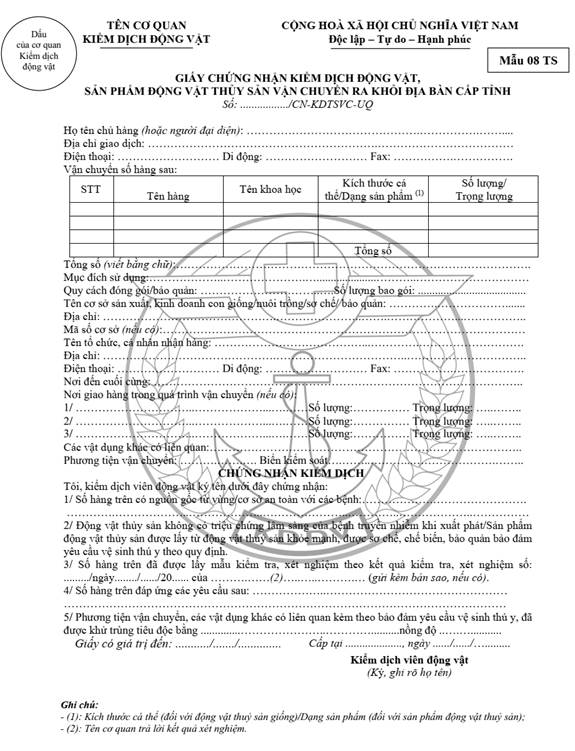
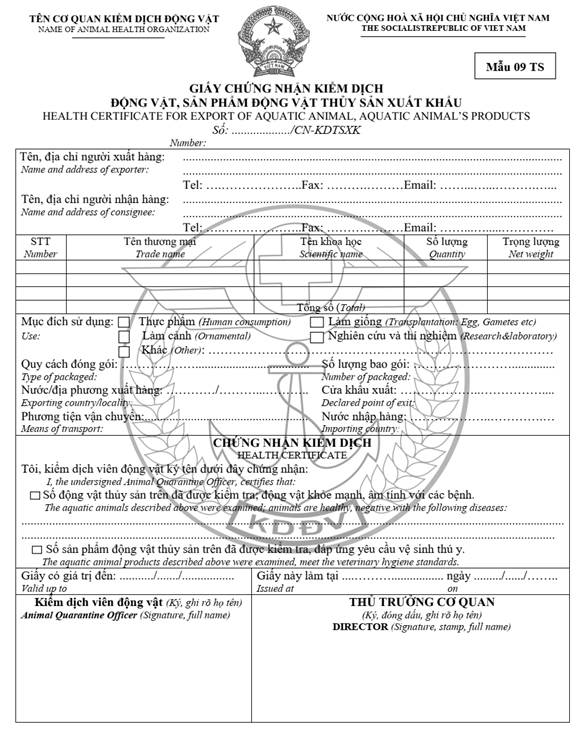
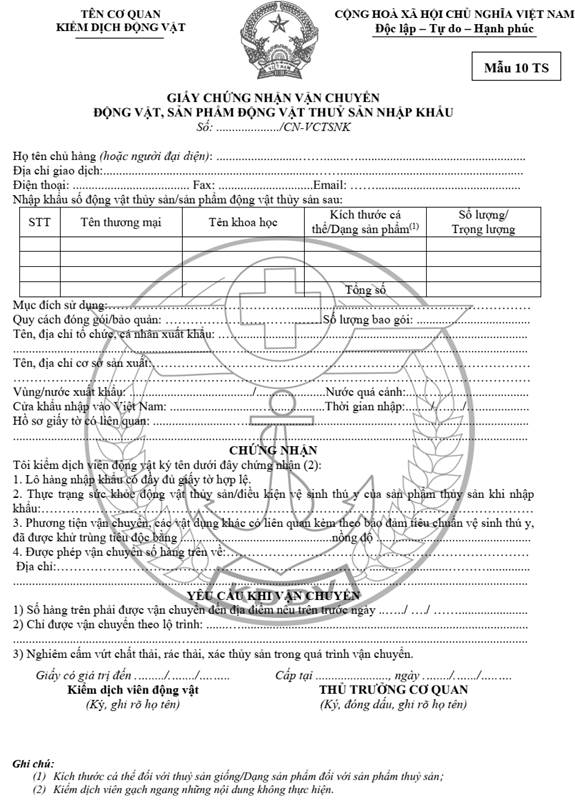
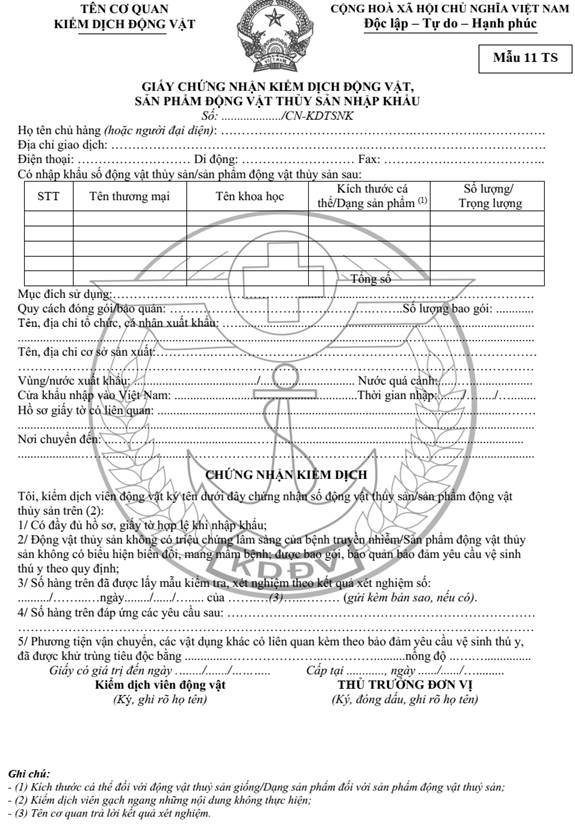
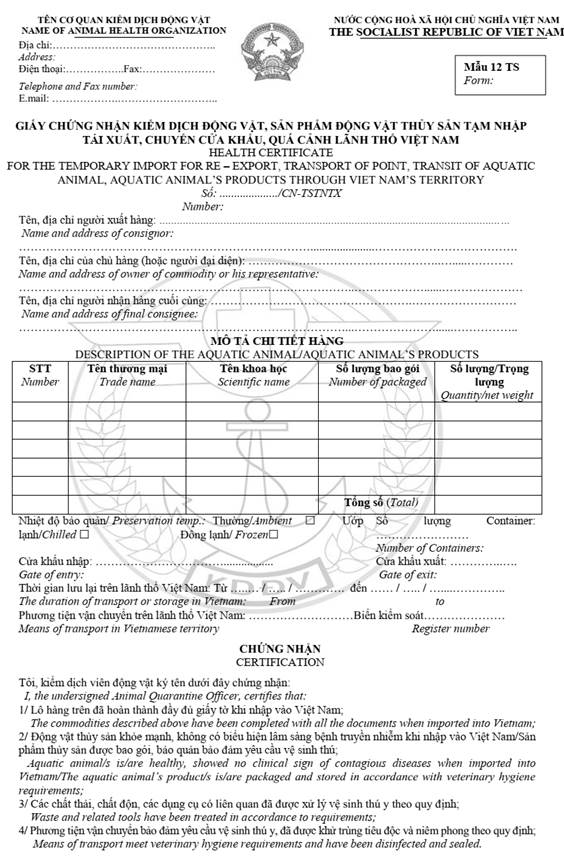
REQUIREMENTS DURING TRANSPORT IN VIETNAM TERRITORY
1/ Allowed itinerary: ……………………………………………………….
2/ Disposal of waste and dead carcasses of aquatic animals during transportation is prohibited;
3/ Any sign of aquatic animals disease/decayed aquatic animal’s products shall be reported to the nearest veterinary authority;
4/ Obey the stipulation of Veterinary ordinance during transportation in Vietnam’s territory.
| Place of issue:……………………………….
|
|
| Valid up to: ……/……/………..
|
Date of issue:……../……../…………………..
|
|
Animal Quarantine Officer (Signature, full name) |
DIRECTOR |
CERTIFICATION OF ANIMAL QUARANTINE ORGANIZATION AT THE POINT OF EXPORT
………………………………………………………………………………………………………
………………………………………………………………………………………………………
………………………………………………………………………………………………………
………………………………………………………………………………………………………
………………………………………………………………………………………………………
………………………………………………………………………………………………………
………………………………………………………………………………………………………
………………………………………………………………………………………………………
………………………………………………………………………………………………………
………………………………………………………………………………………………………
………………………………………………………………………………………………………
|
…………….., date…………………… |
|
|
Animal Quarantine Officer (Signature, full name) |
DIRECTOR |
|
|
THE SOCIALIST REPUBLIC OF VIETNAM
|

RECORD ON VETERINARY HYGIENE STATUS OF AQUATIC ANIMALS AND PRODUCTS THEREOF
No.:………./BB-VSTY
At ……(time)……., …………(date)……..……
At (location): …………………………………………….………..……………………………
We include:
1/ Mr./Ms.: …………………………………………………………….Position: ………………………………..
Officer of the Animal health organization at: ……………………………………………..…………………….
2/ Mr./Ms.: (owner of commodity or representative)
Business address: ………………………………………………………….……………………………………….
Phone number: …………………………….. Fax: ………………………… Email: ……………………………
During the veterinary hygiene inspection of the shipment:
1/ …………………………………………Quantity:…..………Weight: ..………………
2/ ………………………………………… Quantity:…..………Weight: ..………………
3/ ………………………………………… Quantity:…..………Weight: ..………………
Method for veterinary hygiene inspection: …………………………………..…………………………………
…………………………………………………………………………..……………………………………………….
Veterinary hygiene status of the shipment: ……………………………………………….…..………………..
…………………………………………………………………………………………………..
…………………………………………………………………………………………………..
…………………………………………………………………………………………………..
…………………………………………………………………………………………………..
Conclusion:
…………………………………………………………………………………………………..
……………………………………………………………………………………………..………………………
………………………………………………………………………………………………….
Opinions of owner of commodity (or representative):
………………………………….…….………………………………………………………………………………..
……………………………………………………………………………………………………………………………
The record shall be made in 02 copies. 01 copy is kept by the Animal health organization, and 01 copy is kept by the owner of commodity or representative.
|
Owner of commodity (or representative)
|
Animal Quarantine Officer (Signature, full name) |
|
Witness (if any) |
|
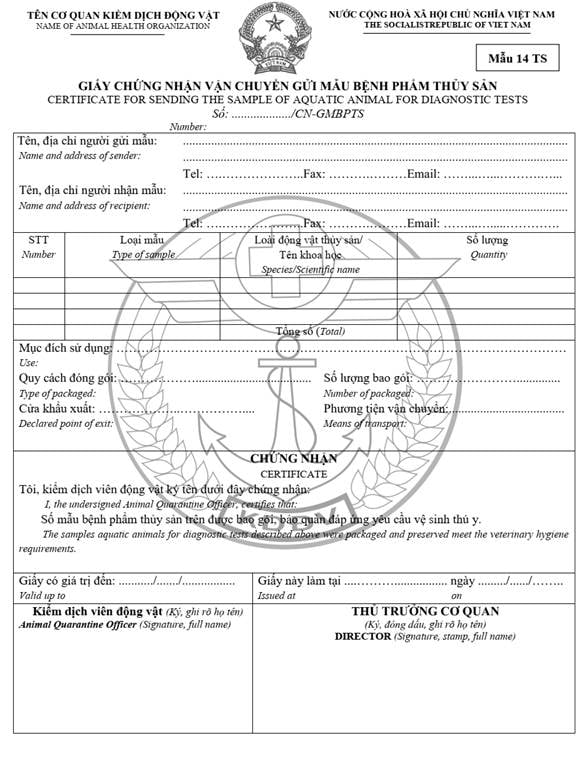
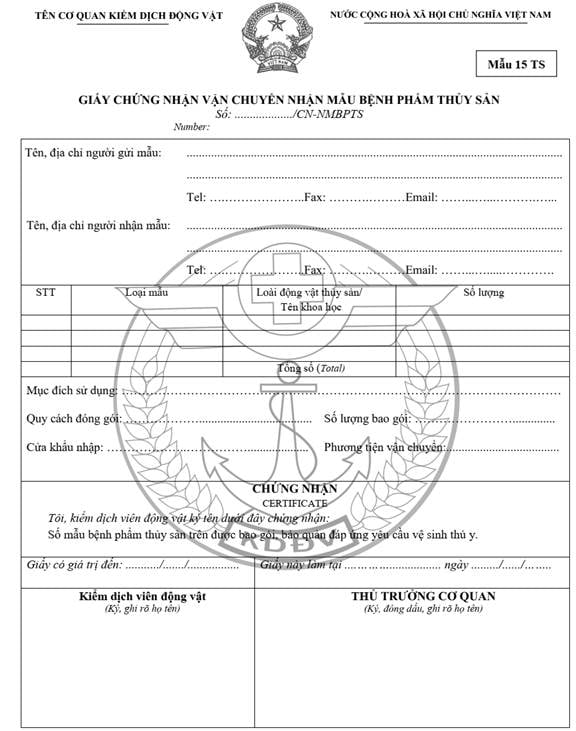
|
|
THE SOCIALIST REPUBLIC OF VIETNAM
|
RECORD ON SEALING OF TRANSPORT MEANS AND CONTAINERS OF AQUATIC ANIMALS AND PRODUCTS THEREOF
No.:………./BB-NP
At ……(time)……., …………(date)……..……, at ………(location)……………
We include:
1/ Mr./Ms.: …………………………………………………………….Position: ………….…………………………
Officer of the Animal health organization at: ……………………………………………..……………………….
2/ Mr./Ms.: …………………………………………………………….Position: ………….…………………………
Officer of the Animal health organization at: ……………………………………………..……………………….
3/ Mr./Ms.: (owner of commodity or representative)
Address: …………………………………………………………………………………………………………………..
Phone number: …………………………. Fax: …………………………. Email: …………………………………..
Proceed to seal transport means and containers of aquatic animals and products thereof as follows:
Type of commodities:……………………………………………………………………………………….
Quantity:………………………………………………………………………………………..
Health certificate No.:…………………………..issued on……………………………
Issued by: ………………………………………………………………………………………………………………
Transport means:………………………………..License plate No.:…………………………….
Seal No.:………………………………………………………………………..
The record shall be made in 02 copies. 01 copy is kept by the Animal health organization, and 01 copy is kept by the owner of commodity or representative.
|
Owner of commodity (or representative) |
Animal Quarantine Officer |
|
|
THE SOCIALIST REPUBLIC OF VIETNAM
|
RECORD ON INSPECTION OF QUARANTINE SITE FOR AQUATIC ANIMALS AND PRODUCTS THEREOF
No.:………./BB-KTVSTY
At ……(time)……., …………(date)……..…… …… ……..……………
At (facility name): ………………………..………………………………….………………………………………..
Address: ………………………………………………………………..………………………………………………
Phone number: …………………………….. Fax: …………………………….. Email: .………………………….
We include:
1/ Mr./Ms.: …………………………………………………………….Position: …….……………………
Officer of the Animal health organization at: …………………………………………………..…………………
2/ Mr./Ms.: …………………………………………………………….Position: ……………….……….
Address: …………………………………………………………….…………………………………………….
Phone number: ……………..…………………….. Fax: ….………….……………………………..…………
3/ Mr./Ms.: …………………………………………………………….Position: ………………….………
Address: ……………………………………………………………………………..………………………..……….
Phone number: ……………..…………………….. Fax: ….…………….…………………………..…………
Have conducted an inspection of quarantine site for aquatic animals and products thereof.
Inspection result:
1. Location: …………………………………………………..…………….………………………………..
2. Area:…………………………………………………………………………………….
3. Design and construction:…………………………………………………………………………..
4. Conditions of equipment and tools: ……………………………………………………………
5. Conditions for farming aquatic animals/storage of aquatic animal products:……..………
…………………………………………………………………………………………..
………………………………………………………………………………………….
6. Clean water supply at the facility: ………………………………………..………………………………
7. Disposal site for aquatic animals and products thereof not meeting veterinary hygiene requirements:
…………………………………………………………………………………………….
8. Drainage system and wastewater treatment: …………………………………………………………..
9. Health conditions of workers at the facility: …………………………………………………
10. Sanitized and disinfected on …………………(date)……………………………..
– Method: ………………….…………………………………………………………………
– Chemicals used: ………………………………………………… Concentration: ………………………………
Conclusion:
………………………………….………………………………………………………………………………………
………………………………………………………………………………………………………………….………
………………………………………………………………………………………………………………….………
………………………………………………………………………………………………………………….……….
………………………………………………………………………………………………………………….……….
– Recommendations (if any):
…………………………………………………………………………………………………………..………………..
……………………………….…………………………………………………………………………….….
……………………………………………………………….…………………………..………
……………………………………………………………….…………………………..………
……………………………………………………………………………………………………
The record shall be made in 02 copies. 01 copy is kept by the Animal health organization, and 01 copy is kept by the facility.
|
Representative of the facility |
Animal Quarantine Officer |
| NAME OF THE ENTERPRISE
Address: ………………..…………..… Phone number: ………………………………..… Fax: ……………………..……..…… Email: …………………………………… No. ……………………………..… |
THE SOCIALIST REPUBLIC OF VIETNAM
|
APPLICATION FOR REPLACEMENT OF HEALTH CERTIFICATE FOR EXPORT OF AQUATIC ANIMALS AND PRODUCTS THEREOF
To: ………………………………………………………………………
Name of enterprise/owner of commodity: …………………………………………….
Address:……………………………………………………………………
Phone number: Fax:…………….. Email: ……………………..
Request for consideration for replacement of Health certificate No……………… issued on…………… by……………………………………
…………………………………………………………………………….
Reasons: …………………………………………………………………….
…………………………………………………………………………….
We hereby commit to comply with laws on veterinary medicine./.
|
DIRECTOR |
|
|
THE SOCIALIST REPUBLIC OF VIETNAM
|

RECORD ON INSPECTION AND SAMPLING
No.:………./BB-KTLM
At ……(time)……., …………(date)……..……
At (location): …………………………………………………………………………………….
We include:
1/ Mr./Ms.: …………………………………………………………….Position: .………………………
Unit: …………………………………………………………………………………………………………………
2/ Mr./Ms.: …………………………………………………………….Position: .………………………
Unit: …………………………………………………………………………………………………………………
3/ Mr./Ms. (owner of commodity or representative):
Business address: ………………………………………………………………………..…………………………
Phone number: …………………………… Fax: ………………………. Email: ..……………………………….
Conduct inspection of the commodities and collect samples, or provide guidelines and supervise the sampling of the following shipment:
|
Name |
Packaging specifications |
Commodities |
Samples |
||
|
Quantity |
Weight |
Quantity |
Weight |
||
|
|
|
|
|
|
|
|
|
|
|
|
|
|
|
Total |
|
|
|
|
|
Conditions of commodities: ………………..…………………..……………………………………………………
……………………………………………………………………………………………………………………………
……………………………………………………………………………………………………………………………
Expected date for result notification: ……………………………………………………………
The record shall be made in 02 copies. 01 copy is kept by the Animal health organization, and 01 copy is kept by the owner of commodity or representative.
|
Owner of commodity (or representative) |
Person collecting samples/Sampling supervisor (2) |
Note:
(1) If the goods are aquatic animals, specify the quantity of individuals. If the goods are aquatic animal products, specify the quantity of packages, boxes, or containers.
(2) If the Animal quarantine officer instructs or supervises the sampling, both the officer and the person collecting samples shall sign and provide their full names.
|
|
THE SOCIALIST REPUBLIC OF VIETNAM
|

RECORD ON UNSEALING OF TRANSPORT MEANS AND CONTAINERS OF AQUATIC ANIMALS AND PRODUCTS THEREOF
No.:………./BB-MNP
At ……(time)……., …………(date)……..…… …… at ….(location)…….
………………………………………………………………………………….…..……………
We include:
1/ Mr./Ms.: …………………………………………………………….Position: ………….……….
Officer of the Animal health organization at: ……………………………………………………….……….
2/ Mr./Ms.: …………………………………………………………….Position: ………….……….
Officer of the customs authority at …………………………. (if any)
3/ Mr./Ms.: (owner of commodity or representative)
Business address: ……………………………………………………………………………………………….
Phone number: ……………………………….. Fax: …………………………. Email: ………………………
In the presence of:
Mr./Ms.: …………………………………………………………….Position: …………………..
Address: …………………………………………………………………………………
Proceed to unseal the transportation means/containers of animals and products thereof for veterinary hygiene inspection.
Veterinary hygiene status of the shipment, transportation means and containers:
………………………………………………………………………………………..…
………………………………………………………………………………………..…
………………………………………………………………………………………..…
………………………………………………………………………………………..…
The record shall be made in 03 copies. 01 copy is kept by the Animal health organization, 01 copy is kept by the custom authority, and 01 copy is kept by the owner of commodity or representative.
|
Owner of commodity (or representative) |
Animal quarantine officer |
|
|
|
|
Witness (if any) |
Representative of customs authority |
|
NAME OF ANIMAL HEALTH ORGANIZATION |
THE SOCIALIST REPUBLIC OF VIETNAM |
|
No.:………./QD-XLVSTY |
………(place of issuance), date………………………….. |
DECISION
VETERINARY HYGIENE TREATMENT OF AQUATIC ANIMALS AND PRODUCTS THEREOF THAT DO NOT SATISFY VETERINARY HYGIENE REQUIREMENTS
COMPETENT ISSUING AUTHORITY (1)
Pursuant to the Law on Veterinary Medicine in 2015;
Pursuant to the Law on amendments to some articles of 15 Laws in the field of agriculture and environment in 2025;
Pursuant to Decision No. ……/ …..…….dated……………. of ….(2)……………….on functions, tasks and powers of …….…..(3);
Pursuant to Record on veterinary hygiene status of aquatic animals and products thereof No……./BB-VSTY dated …………………….. of …………………..(4)………………….
HEREBY DECIDES:
Article 1. The veterinary hygiene treatment of the following commodities:
1/ ………………………….……… Quantity:…..………Weight: …..………..
2/ ………………………….……… Quantity:…..………Weight: …..………..
3/ ………………………….……… Quantity:…..………Weight: …..………..
4/………………………….…………Quantity:……………Weight: …..……..…..
of Mr./Ms.: (owner of commodity or representative)
Business address: ………………………….…………………………………………..
Phone number:……………………………..Fax:…………………………Email: ……………………………….
ID card/Passport No.:…………………………………………………………………………………….
Issued on:……………………………….by: ………………………………………………………………….
The above-mentioned commodities do not satisfy veterinary hygiene requirements as follows:
………………………………………………………………………………….…………………………………….
………………………………………………………………………………….…………………………………….
Relevant items (vehicles, tools, packaging, feed, bedding, waste): ………………………………………………………………………………….………………..
…………………………………………………………………………………………………………………………
Article 2. The method for treatment of the above-mentioned commodities and relevant items: …….……..
…………………………………………………………………………………………………………………………
…………………………………………………………………………………………………………………………
…………………………………………………………………………………………………………………………
Article 3. The location for veterinary hygiene treatment: …………………………………..…………………………
………………………………………………………………………………………………………………………….
………………………………………………………………………………………………………………………….
……………………………………………………………………………………………………………………..….
Article 4. Name and address of organization or individual conducting veterinary hygiene treatment: ……………………….…………….
…………………………………………………………………………………………………………………………
…………………………………………………………………………………………………………………………
………………………………………………………………………………………………………………………..
Article 5. Time for veterinary hygiene treatment: At ……….(time)…………..date……..
Article 6. The treatment location shall be sanitized and disinfected as prescribed by laws.
Article 7. Regulations on use of commodities after veterinary hygiene treatment: ..………………..
…………………………………………………………………………………………………………………………
……………………………………………………………………………………………..………………………….
………………………………………………………………………………………………….……………………..
The Decision shall be made in 03 copies. 01 copy is kept by the Animal health organization, 01 copy is kept by the owner of commodity or representative, and 01 copy is kept by the organization or individual conducting veterinary hygiene treatment.
Recipient: ….. |
DIRECTOR |
Note:
(1) : Head of the issuing authority;
(2) : Competent issuing authority;
(3) : Authority issuing treatment decision;
(4) : Animal health organization.
|
|
THE SOCIALIST REPUBLIC OF VIETNAM
|

RECORD ON VETERINARY HYGIENE TREATMENT FOR AQUATIC ANIMALS AND PRODUCTS THEREOF
No.:………./BB-XLVSTY
At ……(time)……., …………(date)……..……
At (location): ………………………………………………………………………………………….…………….
We include:
1/ Mr./Ms.: …………………………………………………………….Position: …….………………..
Officer of the Animal health organization at: …………………………………………………..……………….
2/ Mr./Ms.: …………………………………………………………….Position: ……………….……..
Address: …………………………………………………………….…………………………………………..
Phone number: ……………..…………………….. Fax: ….………….……………………………..……….
3/ Mr./Ms.: …………………………………………………………….Position: ………………….……
Address: ……………………………………………………………………………..………………………..……..
Phone number: ……………..…………………….. Fax: ….…………….…………………………..……….
Based on Decision on veterinary hygiene treatment of aquatic animals and products thereof that do not satisfy hygiene requirements No……………./QD-XLVSTY dated …………….. of ………………..(1)………………………………………………..………….
We have conducted veterinary hygiene treatment of the following shipment:
Name of commodity: ………………………………………………………………..…………..……..……….
Quantity: …………………………….. Weight: ………………….……………..……..……..
of Mr./Ms.: (owner of commodity or representative)
Business address: ……………………………………………………………………………………………………..
Phone number: ……………………………….. Fax: …………………………. Email: ………………….………….
The method for treatment of the above-mentioned commodities and relevant items: ……………………..…………
……………………………………………………………………………………………………………………………….
……………………………………………………………………………………………………………………………….
……………………………………………………………………………………………………………………………….
……………………………………………………………………………………………………………………………….
……………………………………………………………………………………………………………………………….
The location for veterinary hygiene treatment: ………………………………………………………………………………….……….
………………………………………………………………………………………………………………………………..
Name and address of organization or individual conducting veterinary hygiene treatment: …………………………………………………..…………………………………………………………………………..
………………………………………………………………………………………………………………………………..
………………………………………………………………………………………………………………………………..
The location for veterinary hygiene treatment: at …(time)……. , date………………. ………The treatment location has be sanitized and disinfected as prescribed by laws.
The method for sanitization and disinfection: …………………………………………….……..………………………
Chemicals use disinfection: ………………………………………………… Concentration: ……….
Result: ……………………………………..………………….………..
………………………………………………………………………………………………………………………….……..
………………………………………………………………………………………………………………………….……..
Regulations on use of commodities after veterinary hygiene treatment (in case disposal is not applied):
| 1/ Permitted for use as food: | □ |
| 2/ Permitted for use as animal feed or aquatic feed: | □ |
| 3/ Permitted for processing as raw materials for industry: | □ |
Opinions of the owner of commodities (or representative): ……………………………………………………………….…
…………………………………………………………………………………………………………………………..…
………………………………………………………………………………………………………………………….….
………………………………………………………………………………………………………………………….….
………………………………………………………………………………………………………………………….….
……………………………………………………………………………………………………………………………..
The Decision shall be made in 03 copies. 01 copy is kept by the Animal health organization, 01 copy is kept by the owner of commodities or representative, and 01 copy is kept by the organization or individual conducting veterinary hygiene treatment.
|
Owner of commodity (or representative) |
Animal quarantine officer |
|
|
|
|
Organization or individual conducting veterinary hygiene treatment |
Relevant authorities (if any) |
* Note: (1) Animal health organization.
FORM FOR MANAGEMENT AND SURVEILLANCE OF AQUACULTURE FACILITIES RECOGNIZED AS DISEASE-FREE OR UNDER DISEASE SURVEILLANCE; COLLECTION AND BUSINESS FACILITIES OF AQUATIC ANIMALS USED FOR BREEDING UNDER DISEASE SURVEILLANCE
(Attached to Circular No.…../2026/TT-BNNMT dated…………2026 of the Minister of Agriculture and Environment)
The Department of Agriculture and Environment………..
Sub-department……………………..
Address:………………………..
Phone number:…………………………
Email:……………………………..
1. Brackish water shrimp:
|
No. |
Name and address of the facility |
Designed capacity (individuals) |
Name of disease |
Diseases certified as disease-free |
Diseases under surveillance with no pathogens detected |
||
|
Date of issue |
Expiry date |
Surveillance period |
Surveillance result |
||||
|
|
Example:
Nguyen Van A Address:………………………….. Phone number:……………………. |
White Spot Disease (WSV) |
…/…/… |
…/…/… |
…/…/… |
Negative |
|
| Yellow Head Disease (YHV) |
|
|
|
|
|||
| Taura syndrome |
|
|
|
|
|||
| Infectious hypodermal and hematopoietic necrosis virus (IHHNV) |
|
|
|
|
|||
| Acute hepatopancreatic necrosis disease (AHPND) |
|
|
|
|
|||
| Infectious myonecrosis disease |
|
|
|
|
|||
| Microsporidia |
|
|
|
|
|||
2. For cyprinid fish:
|
No. |
Name and address of the facility |
Designed capacity (individuals) |
Name of disease |
Diseases certified as disease-free |
Diseases under surveillance with no pathogens detected |
||
|
Date of issue |
Expiry date |
Surveillance period |
Surveillance result |
||||
| Spring viremia of carp (SVC) |
…/…/… |
…/…/… | …/…/… |
Negative |
|||
| Koi Herpesvirus Disease | |||||||
3. For pangasius catfish:
|
No. |
Name and address of the facility |
Designed capacity (individuals) |
Name of disease |
Diseases certified as disease-free |
Diseases under surveillance with no pathogens detected |
||
|
Date of issue |
Expiry date |
Surveillance period |
Surveillance result |
||||
| Enteric Septicaemia of Catfish |
…/…/… |
…/…/… | …/…/… |
Negative |
|||
4. For seabass and grouper:
|
No. |
Name and address of the facility |
Designed capacity (individuals) |
Name of disease |
Diseases certified as disease-free |
Diseases under surveillance with no pathogens detected |
||
|
Date of issue |
Expiry date |
Surveillance period |
Surveillance result |
||||
| Viral Nervous Necrosis/Viral Encephalopathy and Retinopathy |
…/…/… |
…/…/… | …/…/… |
Negative |
|||
5. For tilapia:
|
No. |
Name and address of the facility |
Designed capacity (individuals) |
Name of disease |
Diseases certified as disease-free |
Diseases under surveillance with no pathogens detected |
||
|
Date of issue |
Expiry date |
Surveillance period |
Surveillance result |
||||
| Streptococcus/Streptococcosis |
…/…/… |
…/…/… | …/…/… |
Negative |
|||
Note:
The Domestic animal health organization shall prepare a list of aquaculture facilities; and collection and business facilities of aquatic animals used for breeding using this Form as the basis for quarantine of aquatic animals used for breeding upon transportation out of province-level administrative divisions.
PROCEDURES FOR INSPECTION AND SAMPLING OF AQUATIC ANIMALS AND PRODUCTS THEREOF
(Attached to Circular No. …./2026/TT-BNNMT dated …………, 2026 of the Minister of Agriculture and Environment)
I – GENERAL REGULATIONS
1. Definitions
a) Packaging unit means a repeated independent packaging form such as bag, bale, box, bottle, jar, etc., within a shipment.
b) Sample means a portion representing a shipment.
c) Sampling means technical procedures carried out in accordance with principles, procedures and technical requirements as prescribed by laws to collect a representative and homogeneous sample that reflects the actual status of the shipment.
d) Single sample (initial sample) means a quantity of product or packaging unit taken separately at random or intentionally, at the same time and at one position of the shipment.
dd) Pooled sample includes individual samples from the same shipment combined together (either loose or packaged products) to obtain characteristics representing the shipment.
e) Average sample means a portion of the pooled sample or some packaging units taken from the pooled sample.
g) Analytical sample (test sample) means a part taken from the average sample used for analyzing indicators of quarantine, veterinary hygiene and food safety.
h) Retention sample means a sample taken from the average or pooled sample. If it is unable to collect pooled samples, the single sample shall be retained.
2. General principles
Before sampling, relevant documents concerning the shipment and the actual condition of commodities shall be checked. If they satisfy requirements, the sampling shall be carried out.
Homogeneity of the shipment must be guaranteed to ensure that the samples reflect the general condition of the shipment
The sampling shall be conducted scientifically, quickly and conveniently. It shall be carried out transparently and publicly. Samples shall be collected from random positions of the shipment.
If sampling at the border gate is not possible, aquatic animal products shall be taken to the Animal health organization or the warehouse of the owner of commodities for sampling.
II – PROCEDURES
1. Preparation
Before sampling, agree on the time for inspection and sampling with the owner of commodities or the representative.
Prepare relevant documents, forms, sampling tools and appropriate sample storage equipment.
2. Actual inspection
2.1. Inspect veterinary hygiene conditions of transport means, containers and seals.
2.2. Inspect the condition of the commodities;
Inspect at 5 random positions or packaging units at different positions of the shipment. For large shipments of over 100 tons, inspect additional positions/packaging units to ensure the representativeness but no more than 15 positions/packaging units.
For shipments with multiple containers, the person collecting samples shall randomly select and inspect 02 to 04 containers. If suspected, the entire shipment may be inspected.<0}
After inspection, if the shipment satisfies requirements, proceed with sampling for analysis. If the shipment fails to satisfy requirements, the person collecting samples shall not take samples but record and report to the competent authority.
3. Sampling
3.1. Sample quantity and weight
3.1.1. Quantity of samples as prescribed in Section B, Appendix IV of this Circular.
3.1.2. Weight of samples for analysis and retention shall be sufficient to analyze indicators in accordance with the laws and the lab’s analysis method. If samples must be sent to multiple labs, weight of samples shall be increased accordingly.
For large shipments of over 100 tons, the person collecting samples may increase the number of packaging units/product weight for creating the average sample (not exceeding the amount taken from shipments of over 100 tons) and ensure the analytical sample representing the shipment. The average or initial sample weight (in case where the initial sample is equivalent to the average sample) shall be between 500 to 1000 g (excluding bones).
3.2. Analytical sampling
3.2.1. Initial sampling
a) For packaged shipments:
– For shipments consisting of bags, cartons, bales, boxes, etc., initial samples shall be taken from at least 05 packaging units but not exceeding 10 by randomly selecting products from the selected packages. If the shipment has less than 10 packaging units (pallets), initial samples shall be taken from all units. For shipments of over 100 tons, samples shall be taken from no more than 15 packaging units.
– For liquid or semi-solid products, initial samples shall be taken from at least 05 different depths of the packaging unit after thorough mixing.
b) For bulk shipments (in wagons, containers, ship holds, etc.), initial samples shall be taken from at least 05 different positions of the shipment.
3.2.2. Establishment of pooled sample
Combine all collected initial samples to form the pooled sample that represents the shipment.
3.2.3. Establishment of average sample
a) For liquid or semi-solid products, mix the pooled sample thoroughly and withdraw a portion to create the average sample.
b) Fibrous, fragmented, or pelletized products may be subdivided randomly;
c) Large products may be randomly withdrawn (cut down if necessary).
d) For pre-packaged products, packages may be mixed, and products may be withdrawn randomly;
dd) Average sample weight shall be sufficient to analyze indicators and keep retention samples.
3.2.4. Establishment of analytical sample
Divide the average sample into two equal parts: one for analysis and one for retention sample. If it is necessary to send samples to many labs, the analytical sample can be divided accordingly. Sample weight shall be sufficient to analyze all indicators.
3.2.5. Labeling, packaging, sealing, storage and transport of samples
a) Samples shall be packaged, sealed and labeled to ensure confidentiality and avoid mix-ups;
b) Samples should be stored under suitable conditions to maintain their original state.
3.2.6. Sampling record
A sampling record shall be prepared immediately after sampling in accordance with Form 19 TS in Appendix V of this Circular which is witnessed and signed by the owner of commodity and relevant parties.
All information shall be fully and accurately recorded including packaging, storage conditions, production date, expiry date, transport mean and container identifiers, seal number, etc.
3.2.7. Transport and submission of samples
a) Samples shall be transported to the lab as soon as possible using means that do not degrade the quality of samples.
b) Samples sent to labs shall have intact labels with all information. Labels shall not be blurred or torn, and be sealed so samples cannot be taken without breaking seals. Containers shall protect samples from light, heat, or other factors affecting their quality.
3.2.8. Retention and disposal of samples
Retention samples are stored under suitable conditions for 30 days with quantities appropriate for testing methods.
After expiration, retention samples shall be disposed as prescribed by laws.
3.2.9. Returning samples
If initial samples must be taken at a facility other than the inspection site, after sampling, a Record on returning remaining samples to the owner of the commodity shall be prepared in accordance with the Form for returning remaining samples attached to this Appendix.
4. Shipments with multiple product types
Inspection and sampling for each product type shall comply with point 2, Section II and point 3, Section II of this Appendix for each product type (selecting no more than 03 product types for sampling)./.
Form for returning remaining samples
|
|
THE SOCIALIST REPUBLIC OF VIETNAM
|

FORM FOR RETURNING REMAINING SAMPLES
No.:………./BB-TLMT
At ……(time)……., …………(date)……..……
At (location): …………………………………………………………………………………….
We include:
1/ Mr./Ms.: …………………………………………………………….Position: .……………………….
Representative of the Animal health organization: ……………………………………………………………………….
2/ Mr./Ms. (owner of commodity or representative):
Business address: ………………………………………………………………………..………………………….
Phone number: …………………………… Fax: ………………………. Email: ..………………………………..
We hereby agree and acknowledge the handover of the remaining samples after sampling the shipment for inspection and testing as follows:
|
No. |
Name of sample |
Unit |
Quantity of initial samples |
Quantity of samples for testing |
Quantity of returned samples |
Note |
|
|
|
|
|
|
|
|
|
|
|
|
|
|
|
|
|
|
|
|
|
|
|
|
|
|
Total |
|
|
|
|
|
Condition of remaining samples: ………………..…………………..………………………………………….
………………………………………………………………………………………………………………………………
………………………………………………………………………………………………………………………………
The record shall be made in 02 copies. 01 copy is kept by the Animal health organization, and 01 copy is kept by the owner of commodity or representative./.
|
Owner of commodity (or representative) |
Person returning samples |

